
Indigo Anti-Detect Browser Review: Is It Worth It in 2026?
Take a Quick Look
Read our thorough Indigo antidetect browser review covering features, pricing, fingerprinting, automation, and real-world use cases for multi-accounting & traffic arbitrage.
🔥 Limited-Time Offer! Save extra 10% off on your first monthly plan with code: Anitdetect10
Sign upIndigo Anti-Detect Browser Review: A Tool for Serious Multi-Accounting?
Managing dozens or hundreds of online accounts without triggering fraud systems has never been simple. Indigo антидетект браузер (anti-detection browser) promises a complete environment for multi-accounting, traffic arbitrage, web scraping, and more. Built on over seven years of anti-detection development, Indigo aims to make each browser profile look like a genuine, standalone device. In this evidence-based review, we examine exactly who Indigo works for, how it handles fingerprinting, what the real-world setup feels like, and whether its pricing holds up against alternatives. By the end, you'll know if Indigo deserves a spot in your workflow.
Who Should Use Indigo?
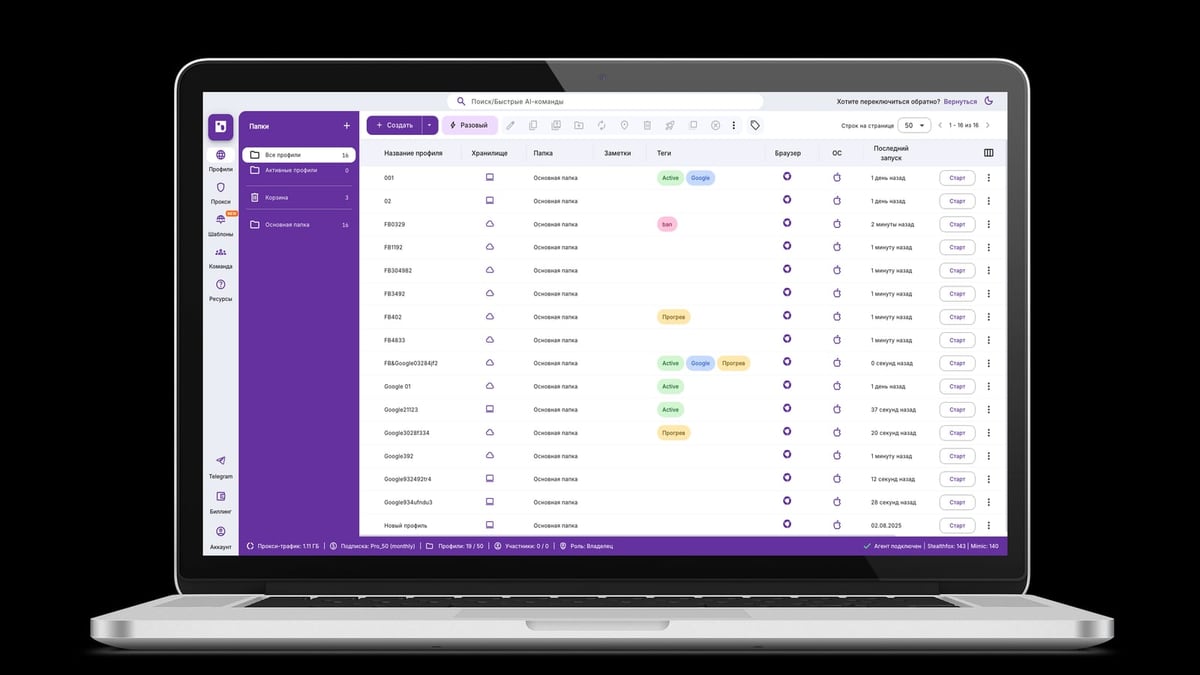
Indigo Anti-Detect Browser Review: Is It Worth It in 2026? product interface and feature overview.
Indigo is purpose-built for professionals who need large-scale account isolation and anonymity. Its feature set targets several high-stakes activities where detection equals lost ad accounts, blocked scrapers, or frozen bonuses.
- Traffic Arbitrage Specialists — Run multiple ad accounts on platforms like Facebook, TikTok, or Google Ads without triggering multi-accounting bans. Indigo's native fingerprints and proxy integration help keep each account environment completely separate.
- Web Scraping & Automation Engineers — When paired with the right proxy setup, Indigo masks automated requests so data extraction looks like organic traffic. Its automation API supports Selenium, Puppeteer, and Playwright, making it a candidate for top-tier scraping pipelines.
- Bonus Hunters & Airdrop Farmers — Safely use multiple accounts on betting platforms or claim airdrops without revealing the same device. Profile cloning lets you scale quickly.
- E-commerce Sellers & Digital Agencies — Manage seller accounts across marketplaces or handle client ad campaigns without shadow bans. Role-based access control and encrypted cloud storage keep sensitive data safe.
If your daily work involves any form of multi-accounting that must survive anti-fraud scrutiny, Indigo's toolset is designed for exactly that.
Key Features of Indigo Antidetect Browser
Indigo Anti-Detect Browser Review: Is It Worth It in 2026? product interface and feature overview.
Indigo bundles several technical capabilities under one roof. Here's what sets it apart.
Dual Browser Engines: Stealthfox and Mimic
Unlike many anti-detect browsers that rely solely on a Chromium base, Indigo offers two separate engines:
- Mimic — Based on Chromium (currently core 148), it mimics the behaviour and footprint of a standard Google Chrome installation. Ideal for sites that predominantly see Chrome traffic.
- Stealthfox — Built on a Firefox core (146), it creates a different fingerprint class altogether. This variety gives you flexibility when a site's anti-fraud logic heavily profiles Chrome users, or when you simply need a secondary browser identity.
Both engines are updated alongside fingerprint databases, with the latest refresh recorded on the official Indigo website as of July 2026. You can create, clone, and transfer profiles across both engines without restrictions.
Mobile Antidetect with Indigo X
Indigo X adds a mobile browser emulation layer that runs on your desktop. Rather than managing a physical phone farm, you can spin up mobile profiles (iOS or Android) that pass real-device checks. This is particularly useful for social media platforms where mobile-only campaigns are common. Automation support extends to these mobile profiles via Selenium, Playwright, and Puppeteer, so mobile scraping becomes feasible without any additional hardware.
Local vs. Encrypted Cloud Storage
When you create a browser profile, you decide where to house it:
- Local storage keeps everything on your own machine — suitable for users who want full control and no external data transfer.
- Encrypted cloud storage syncs profiles across devices and team members. Since the data is encrypted before leaving your system, even Indigo cannot read your session data. This is a robust option for agencies that need to share accounts without exposing plain-text cookies.
Automation via API
Indigo's API is designed for headless and automated workflows. It supports:
- Selenium Hardened
- Puppeteer Hardened
- Playwright (currently for Mimic profiles only)
The API respects rate limits based on your plan — for example, PRO 10 allows 50 requests per minute, while PRO 50 and above bump you to 100 RPM. Higher limits on the Business tier make large-scale scraping or bulk ad creation smoother. Knowledge base documentation and code examples help get automation running quickly.
Built-In Proxy Management
Indigo includes integrated residential proxies covering over 150 countries. New profiles can be set up with a proxy in under two minutes. An internal proxy checker validates connectivity and cleanliness before you launch a session. If you prefer your own proxies, the browser works with HTTP, HTTPS, and SOCKS5 protocols. The plan you choose includes a set amount of proxy traffic (from 200 MB on the trial up to 10 GB on Business), which can be a cost-effective way to start without a separate proxy subscription.
Fingerprint Database & Regular Updates
The core of any anti-detect browser is its fingerprint engine. Indigo generates fingerprints from a continuously updated database of real user data. Parameters like Canvas, WebGL, fonts, screen resolution, CPU cores, and RAM are all randomised to match plausible hardware configurations. The last documented update (12.12.2024) shows an active maintenance schedule, and the 27.07.2026 update on their homepage indicates the team keeps the database current. This matters because stale fingerprints are easier for platforms to flag.
Setup and First Impressions

Indigo Anti-Detect Browser Review: Is It Worth It in 2026? product interface and feature overview.
Getting started with Indigo feels straightforward: download the desktop app, create an account, and you're dropped into the profile dashboard. No complex registration hoops — the 10-day trial activates immediately, giving you up to 50 profiles to experiment with.
Creating a new profile takes about two minutes. You choose between Stealthfox and Mimic, assign a proxy, and optionally tweak fingerprint settings. Indigo auto-generates a fingerprint that matches your chosen operating system and browser engine, but you can manually override details like language, timezone, or screen resolution if needed.
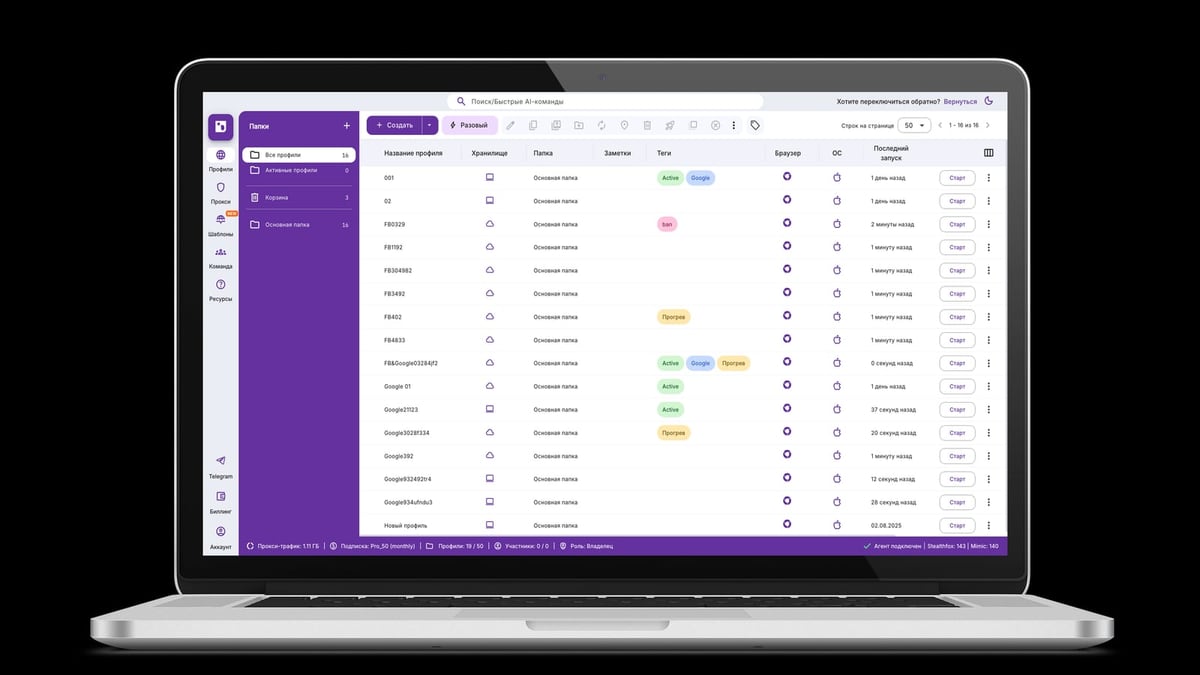
The interface is functional rather than flashy. Profiles are listed in a clean table with quick actions for launch, clone, and delete. Bulk operations are limited on lower plans, but the Business tier introduces team management, where you can group profiles into projects and assign role-based permissions. Agents and agencies will appreciate this layer of access control.
One nuance to watch: closing the main dashboard window terminates all running browser instances without warning. Save your work before shutting things down. While the behaviour is consistent with some other anti-detect browsers, it's a small friction point.
Indigo Pricing: What Each Plan Includes
Indigo Anti-Detect Browser Review: Is It Worth It in 2026? - supporting product research image 4.
Indigo's pricing is tiered by profile count, API access, team features, and proxy traffic. Here's a snapshot of the plans available at the time of writing:
| Plan | Profiles | Team Members | API RPM | Proxy Traffic | Automation |
|---|---|---|---|---|---|
| 10-day Trial | 50 | 0 | 50 | 200 MB | Yes |
| PRO 10 | 10 | 0 | 50 | 1 GB | Yes |
| PRO 50 | 50 | 0 | 100 | 3 GB | Yes |
| PRO 100 | 100 | 2 | 100 | 5 GB | Yes |
| Business | 300 | Unlimited | 100 | 10 GB | Yes |
All paid plans include local and cloud profiles, Mimic and Stealthfox support, fingerprint customisation, and API access. The Business tier unlocks unlimited team members and the highest profile count, making it suitable for large agencies. Trial users get a generous 50 profiles to evaluate the full product before committing.
Note that proxy traffic is included but metered. If you run many bandwidth-heavy sessions, you may need an external proxy subscription to keep costs predictable. The built-in traffic is a great way to test the waters, however.
Strengths of the Indigo Anti-Detect Browser
From hands-on testing and a careful review of its specifications, several clear advantages emerge:
- Dual-engine strategy — Having both a Chromium and a Firefox core means you're not locked into one fingerprint class. This alone can reduce detection patterns that rely on browser family grouping.
- 99.98% uptime guarantee — For any tool running mission-critical ad accounts or scrapers, reliability matters. The published uptime figure is backed by a multi-language support team.
- Mobile emulation without phones — Indigo X can emulate a mobile browser with a high degree of fidelity, saving the cost and complexity of hardware farms.
- Regular fingerprint updates — A stale fingerprint database is a liability. Indigo's consistent refresh cadence keeps profiles aligned with real-world hardware signatures.
- Encrypted cloud storage — Teams can collaborate on the same profiles without exposing credentials, which is a must for agencies and large arbitrage setups.
Limitations to Consider
No tool is perfect, and Indigo has areas where it may fall short for some users:
- Desktop-only application — While mobile profiles are emulated, the Indigo management application itself is not available on Linux, and mobile installation is limited to desktop usage. Mac and Windows users are supported, but Linux-based scraping servers may miss out.
- Automation limited to Mimic for Playwright — If you rely on Playwright for Stealthfox profiles, you'll need to switch to Selenium or Puppeteer. Not a deal-breaker, but it adds a step.
- No granular profile tagging or folders on lower plans — Organising hundreds of profiles without team features feels barebones. Tags and folders would improve workflow, especially for solopreneurs.
- Dashboard shut-down quirk — Closing the window ends all sessions, which can interrupt workflows. You'll learn to save first, but it's an annoyance.
- Pricing scales with proxy traffic — Once you exceed the included bandwidth, you'll need to budget for external proxies. This is standard across the industry but worth factoring into total cost.
How Indigo Compares to Other Anti-Detect Browsers
If Indigo doesn't tick every box, several well-regarded alternatives exist. A detailed look at AdsPower vs VMLogin vs Genlogin shows that each browser has distinct strengths in fingerprinting sophistication, automation APIs, and team features. For instance, AdsPower offers a broader range of automation integrations and a built-in RPA engine, while VMLogin excels at clean fingerprint generation. Gologin, reviewed in another context, provides native Mac, Windows, Linux, and Android support with a polished collaboration suite.
Another capable contender is Hidemyacc, which appeals to users needing straightforward multi-accounting on a budget. However, it lacks the dual-engine approach and mobile emulation found in Indigo. When your work depends heavily on mimicking Firefox environments or running mobile accounts, Indigo's Stealthfox and Indigo X give it an edge that simpler browsers cannot match.
For agencies that manage a high volume of clients, Indigo's encrypted cloud storage and unlimited team accounts on the Business plan are strong differentiators. But if you need advanced automation with full Playwright support across both engines, the comparison with AdsPower or Gologin becomes more nuanced. We suggest exploring our complete anti-detect browser comparison resources to match your exact requirements.
Related reading
- How to Use AdsPower with Fingerprint: A Complete Integration Guide - Learn to integrate AdsPower anti-detect browser with Fingerprint device intelligence. Step-by-step setup, use cases, and how to test browser fingerprints thoroughly.
- TikTok for Business Review: Features, Costs & Real User Insights - Unbiased TikTok for Business review exploring ad formats, targeting, pricing, and real user feedback. Learn its strengths, limitations, and whether it fits your brand.
Sources and further reading
- Che Browser vs Gologin: Honest Review 2026 - Anti-detect browsers frequently advertise as solutions to unreasonable limitations set by tech companies that pull all the digital strings. The one we'll be
- Advanced Anti-Detect Browser for Web Scraping and Multiple Accounts Managing - Nstbrowser is a powerful anti-detect browser designed for multi-accounting professionals to manage multiple accounts securely and efficiently. Try it now for free!
Frequently Asked Questions
Is Indigo antidetect browser free?
No, Indigo is a paid product after the 10-day trial. The trial gives you 50 profiles and 200 MB of proxy traffic to test the tool. Subscription plans then start from the PRO 10 tier.
How does Indigo prevent browser fingerprinting?
Indigo replaces all key fingerprint parameters — Canvas, WebGL, fonts, User-Agent, timezone, language, and hardware details — with realistic values drawn from a database of genuine user configurations. It also uses two browser cores, Stealthfox and Mimic, to provide different fingerprint profiles.
Can I use Indigo for web scraping without getting blocked?
Yes, many users leverage Indigo for web scraping. Combined with clean residential proxies and rotating fingerprints, it significantly reduces the chance of detection. The automation API lets you write scripts with Selenium, Puppeteer, or Playwright. For a broader view of scraping infrastructure, check our guide on the top web scraping APIs.
Is Indigo compatible with macOS and Linux?
At present, Indigo is available for Windows and macOS. Linux is not officially supported, which may be a limiting factor for some server environments.
How many profiles can I create on Indigo?
The limit depends on your plan: from 10 profiles on PRO 10 up to 300 on the Business tier. The trial lets you test up to 50 profiles.
Does Indigo offer team collaboration features?
Yes, the PRO 100 plan includes two team member seats, while the Business plan provides unlimited team accounts. Administrators can assign access rights to projects and profiles, and all cloud-stored data is encrypted.
Conclusion: Is Indigo the Right Anti-Detect Browser for You?
Indigo anti-detect browser is a purpose-built, mature tool for professionals who need bulletproof multi-account isolation. Its dual-engine design, mobile emulation without physical devices, and encrypted collaboration features make it a compelling choice for traffic arbitrage, scraping, and agency work. The generous 10-day trial gives you ample room to test whether it passes your target platforms' security checks.
That said, Indigo's desktop-only management and Playwright limitation for Stealthfox may push some users toward alternatives like Gologin or AdsPower. If your work revolves around Firefox-based fingerprints or requires handling a large number of mobile-only accounts, Indigo's Stealthfox and Indigo X could be exactly the advantage you need. As you evaluate anti-detection solutions, remember that AdsPower keeps a curated lens on the tools that truly move the needle — so you can invest your time where it counts.