
Hidemium Review 2026: Fingerprints, Pricing & Real Limits
Take a Quick Look
Evidence-based Hidemium review: fingerprint test results, proxy handling, automation, pricing signals, setup friction, and who should choose it in 2026.
Hidemium Review 2026: Fingerprints, Pricing & Real Limits
Hidemium is a Vietnamese-built antidetect browser that has moved from a regional tool into the international multi-accounting market. It promises isolated profiles, consistent fingerprints, built-in automation, and a free tier — at prices that undercut several Western competitors. But does it hold up under real fingerprint checks, and where does it fall short? This review pulls together independent test results, user feedback, and hands-on reports to help you decide whether Hidemium belongs in your stack.
What Hidemium Is and Who It Targets
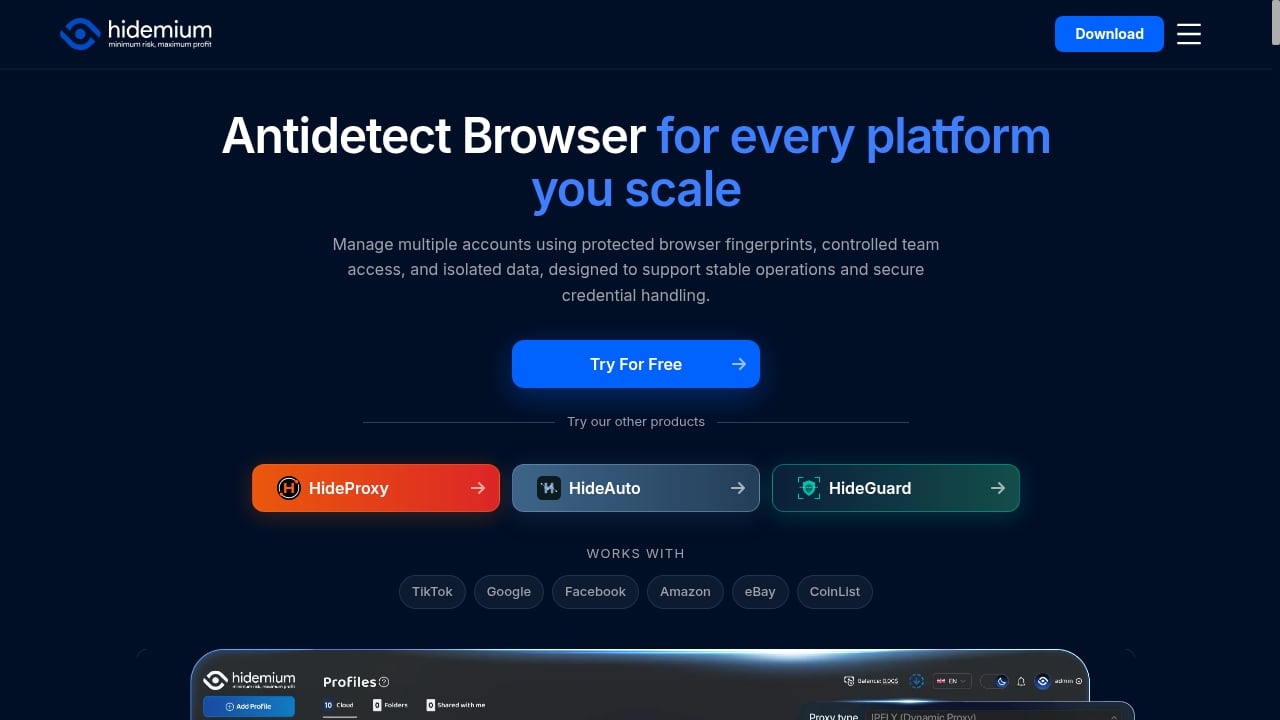
First viewport screenshot of hidemium.io.
Hidemium creates separate browser profiles, each with its own cookies, local storage, proxy settings, and hardware parameters. The goal is simple: websites should see each profile as a distinct real user, not as one person running many accounts. The product is aimed at e-commerce sellers, social media marketers, affiliate marketers, advertisers, and web scrapers who need to operate multiple accounts without triggering bans.
The vendor reports over 36,000 users and more than 10 million profiles created. Its core user base has historically been concentrated in Vietnam and Southeast Asia, where feedback flows through Telegram and Facebook groups rather than Western review platforms. That context matters: public review volume on sites like G2 and Trustpilot is thin, so you should weigh independent technical tests more heavily than star ratings.
Fingerprint Performance: What Independent Tests Show
First viewport screenshot of hidemium.io.
Fingerprint masking is the whole point of an antidetect browser, so this is where Hidemium deserves the closest scrutiny.
2026 test results
In an October 2026 comparison test run on Windows 11 with fresh US residential proxies, Hidemium passed three major checkers:
- Pixelscan: fingerprint reported as consistent.
- Iphey: rated Trustworthy with an MX score of 100.
- CreepJS: 0% headless, 0% tampering, and 25% "like headless," with no lies detected.
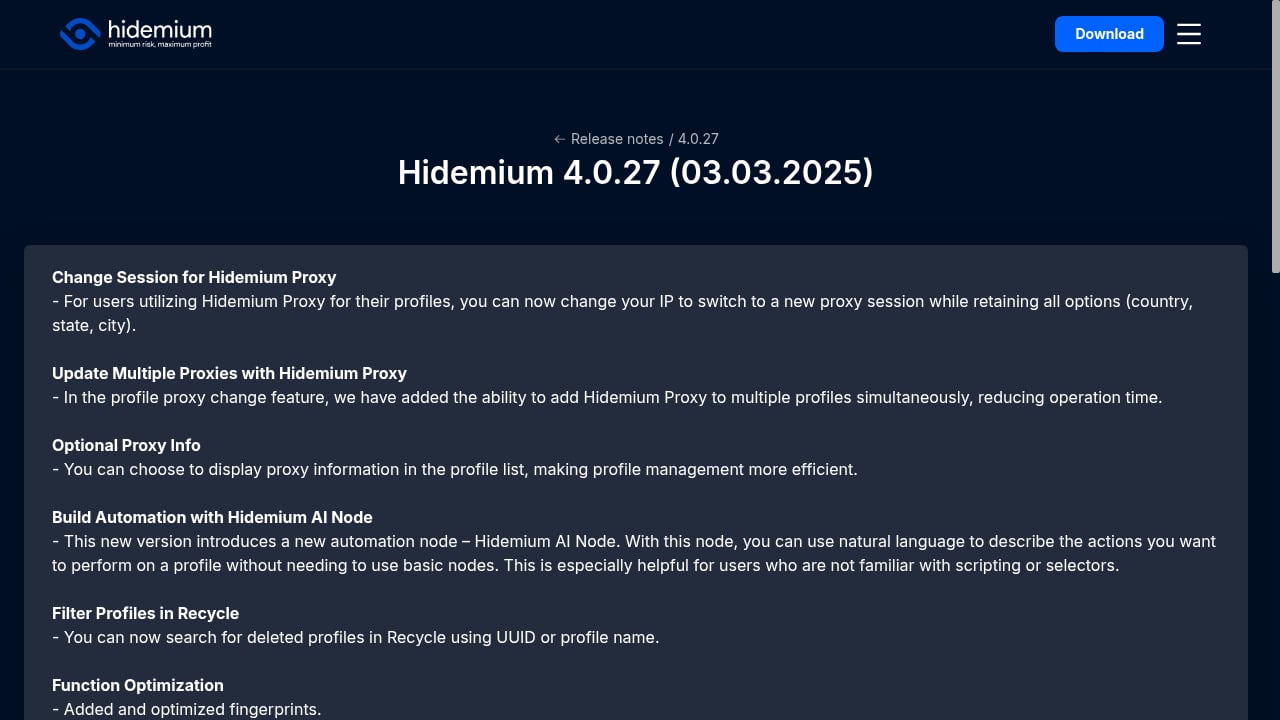
That is a meaningful improvement over the prior year, when the same test found Hidemium failing every checker due to proxy and timezone mismatches. The lesson is that Hidemium can perform well, but configuration quality determines the outcome.
Configuration is not optional
Hands-on reports consistently show that default settings are not enough. WebRTC must be set to Block or Replace; otherwise a real IP can leak even while a proxy is active. Timezone and language should match the proxy's geolocation. The profile OS should match your real system unless you have a specific reason to emulate another platform. Canvas randomization runs at the Chromium engine level rather than through JavaScript injection, which is generally harder to detect — a genuine strength.
Engine lag
On test day, Hidemium ran on Chrome 153 while the latest stable was 154. A one-version lag is minor, but it is worth monitoring if you operate in categories where anti-fraud systems are aggressive.
Setup and First-Launch Friction
First viewport screenshot of hidemium.io.
Installation is quick — roughly three minutes on a modest machine (4 CPU cores, 8 GB RAM). You register with email, confirm, and download the desktop app. Login uses a code sent to your inbox, so check spam if the code does not arrive.
Two setup issues appear repeatedly in hands-on reports:
- Cyrillic Windows usernames can break profile creation. If your Windows user folder contains non-Latin characters, Hidemium may fail to create working directories. The workaround is to create a Windows user with a Latin-character name.
- Proxy import is rigid. Hidemium accepts a single pipe-delimited format such as
host:port|login|password. If your provider exportslogin:password@host:portor colon-delimited lists, you will need to convert them manually or script the transformation.
These are not dealbreakers, but they signal that the product was built with an Asian-and-English-first audience in mind. Teams that need instant English-language support should factor that into their evaluation.
Core Features That Matter
Profile isolation and fingerprint database
Each profile gets its own cookies, cache, local storage, and hardware parameters. Fingerprints are drawn from a database of configurations based on real devices. The free plan exposes a limited slice of that database (reported at 10,000 configurations), while higher tiers unlock millions and, at the top, unlimited configurations. Paid plans also unlock full hardware customization — CPU cores, RAM, screen resolution, GPU, device memory, and speech voices — plus OS emulation for Android and iOS inside desktop profiles.
Proxy management
Hidemium includes a dedicated proxy manager for importing, testing, and assigning HTTP, HTTPS, SOCKS4, SOCKS5, and SSH proxies. It supports IPv6 and sells its own proxy traffic. New paid Local plan purchases include 500 MB of proxy traffic, and daily free ISP proxies are offered. For serious work, bring your own trusted residential or mobile proxies; free proxy quality is rarely sufficient for high-value accounts.
Automation
Hidemium offers Puppeteer support, a local API compatible with Selenium and Playwright, a synchronizer for controlling multiple profiles at once, and a drag-and-drop script builder. Paid Cloud plans include an AI agent that writes automation scripts, with model options listed as Anthropic, OpenAI, and Gemini depending on tier. The AI assistant has been reported as beta and Vietnamese-only in earlier versions, so verify current language support before relying on it.
Team access and storage
Cloud plans include team seats: one member on Basic and Advanced, ten on Premium, and twenty on Business. Local Lifetime plans include five or ten seats. Profiles can be stored locally, on Google Drive, or on your own server with Local plans, or in Hidemium's cloud with Cloud plans. Local backup storage is available, which appeals to teams with data-residency concerns.
Bulk operations
Hidemium supports bulk profile creation from cookie files and a CookieRobot feature that visits a list of sites to warm up profiles with cookies and browsing history. This is useful for preparing accounts before running ads. If bulk profile workflows are central to your operation, it is worth comparing how other tools handle batch actions — see our guide to bulk actions for profiles for context on what mature batch tooling looks like.
Pricing Signals
Pricing was checked on vendor sites in November 2026 and should be treated as directional rather than final.
| Plan tier | Profiles | Approx. monthly (yearly billing) | Notes |
|---|---|---|---|
| Free | 5 | $0 | 1 device, limited fingerprint configs, Chrome on Windows/Linux/Mac only |
| Basic | 30 | ~$12.75 | 1 team member, 60 new profiles/day |
| Advanced | 100 | ~$17 | 1 team member, 200 new profiles/day |
| Premium | 1,000 | ~$59.50 | 10 team members, 2,000 new profiles/day |
| Lifetime Local | Unlimited local | ~$700 one-time | 5–10 team members, local/cloud storage options |
Yearly billing carries roughly a 15% discount. Payment methods include PayPal, crypto, and bank transfer. At 100 profiles and above, Hidemium is consistently cheaper than Gologin. At 25–30 profiles, Gologin's entry pricing is lower. Hidemium also imposes daily limits on new profile creation, which matters if you scale in bursts.
One caveat worth knowing: Gologin has publicly noted that Hidemium's website mirrors its design and copy. That is a credibility signal to weigh alongside the technical results, not a reason to dismiss the product outright.
Strengths and Limitations
Strengths
- Passed Pixelscan, Iphey, and CreepJS in independent 2026 testing.
- Engine-level canvas randomization is harder to detect than JS-injected masking.
- Aggressive pricing at scale, especially at 100+ profiles.
- Free plan with 5 permanent profiles and no credit card.
- Built-in automation, AI script generation, and a synchronizer.
- Local storage and lifetime licensing options for data-sensitive teams.
Limitations
- Interface is busy; users coming from minimalist tools will need an adjustment period.
- Proxy import format is restrictive.
- Cyrillic Windows usernames can block first launch.
- English-language support is not instant.
- Thin public review footprint outside Asian markets.
- Daily caps on new profile creation.
- No native Linux or mobile apps (desktop only), though profiles can emulate mobile platforms.
Hidemium vs Alternatives: Decision Criteria
Hidemium product interface.
Choose Hidemium if you need hundreds of profiles on a tight budget, want to keep profiles on your own machine, and are comfortable tuning fingerprint settings manually. It is a strong fit for affiliate marketers and SMM managers running many accounts across TikTok, Facebook, Google, Amazon, eBay, or crypto platforms like CoinList.
Look elsewhere if you need a free trial of every paid feature, included residential proxy traffic, native Linux or mobile apps, or a vendor with a long public track record. Gologin offers a 7-day trial and proxy traffic from its Professional 25 tier; AdsPower and Octo Browser are also worth comparing. For a broader view, see our top 10 anti-detect browsers and cloud phones for 2026 and our AdsPower vs Octo Browser vs StealthBrowser comparison.
If cost is your primary constraint, read our analysis of free tier security in anti-detect browsers before committing to any free plan — including Hidemium's.
Related reading
- How to Use AdsPower with IPBurger: Setup, Workflow & Tips - Learn how to integrate IPBurger proxies with AdsPower. Step-by-step setup, proxy type selection, and best practices for multi-account management.
Sources and further reading
- Hidemium Antidetect Browser Reviews (2026) - Product Hunt - It's super easy to use, even for beginners, and the interface is clean and intuitive. I've noticed a significant improvement in my online privacy since using it ...
- Hidemium Antidetect Browser Review: Is It Worth It in 2026? - We tested Hidemium on Windows 10 with real proxies. Fingerprint checks, WebRTC leak tests, automation tools, pricing, and honest user feedback inside.
- Hidemium Review 2026: Pricing, Fingerprint Tests vs Gologin - Hidemium passed Pixelscan, Iphey and CreepJS in our October 2026 test. See every Hidemium plan from $153/year, its limits, pros and cons, and how Gologin compares.
Frequently Asked Questions
Is Hidemium detectable? In independent October 2026 tests, Hidemium passed Pixelscan, Iphey, and CreepJS with no tampering detected. However, results depend heavily on correct proxy, timezone, and WebRTC configuration. Default settings are not sufficient.
Does Hidemium have a free plan? Yes. The free plan includes 5 permanent profiles on one device, with no credit card required. It is limited to Chrome on Windows, macOS, and Linux, and exposes a smaller fingerprint database.
How much does Hidemium cost? Paid plans start around $12.75/month on yearly billing for 30 profiles and scale to roughly $59.50/month for 1,000 profiles. A lifetime local license is available for around $700 one-time.
What proxies does Hidemium support? HTTP, HTTPS, SOCKS4, SOCKS5, and SSH, including IPv6. Proxy import uses a pipe-delimited format, so you may need to convert exports from your provider.
Can Hidemium run on Linux or mobile? The desktop app runs on Windows and macOS. Profiles can emulate Android or iOS platforms, but there are no native Linux or mobile apps.
Is Hidemium good for teams? Cloud plans include team seats (1 to 20 depending on tier), and Local Lifetime plans include 5–10 seats. Role-based access and controlled team permissions are supported, but teams needing instant English support may prefer a Western vendor.
Conclusion
Hidemium has matured into a credible antidetect browser. Its 2026 fingerprint results are genuinely strong, its pricing at scale is aggressive, and its automation and local-storage options give it real utility for affiliate marketers, e-commerce sellers, and scraper teams. The trade-offs are real too: a busy interface, rigid proxy import, setup quirks, and a thin public review record outside its home market.
If you are willing to invest an hour in configuration and bring your own quality proxies, Hidemium can deliver solid value — especially at 100 profiles or more. If you need hand-holding, included proxy traffic, or native mobile apps, compare it against Gologin, AdsPower, or Octo Browser before committing. Either way, test with your own proxies and run the checkers yourself; no review, including this one, substitutes for verifying your own setup.


