
AdsPower vs Indigo: Which Anti-Detect Browser Wins?
Take a Quick Look
AdsPower vs Indigo compared: fingerprint depth, browser cores, automation, team tools, pricing, and security so you can pick the right anti-detect browser.
AdsPower vs Indigo: Which Anti-Detect Browser Wins?
Choosing between AdsPower and Indigo usually comes down to one question: do you need a mature multi-accounting platform with team controls and no-code automation, or a lighter anonymity tool with two browser cores and a regularly updated fingerprint database? Both products target people who run many accounts, but they are built for different workflows. This comparison breaks down fingerprints, browser engines, automation, collaboration, pricing, and security so you can match the tool to your actual workload.
Quick verdict
- Choose AdsPower if you manage dozens to hundreds of profiles, need batch operations, role-based team access, cross-device sync, and no-code automation without writing scripts.
- Choose Indigo if your priority is anonymity for traffic arbitrage, bonus hunting, bounty and airdrop tasks, or web scraping, and you are comfortable with a smaller ecosystem and two browser cores.
- Test both if you are unsure. AdsPower offers a 7-day free trial, and Indigo offers a free trial as well, so you can validate fingerprint quality against your own target platforms before paying.
What each browser actually is
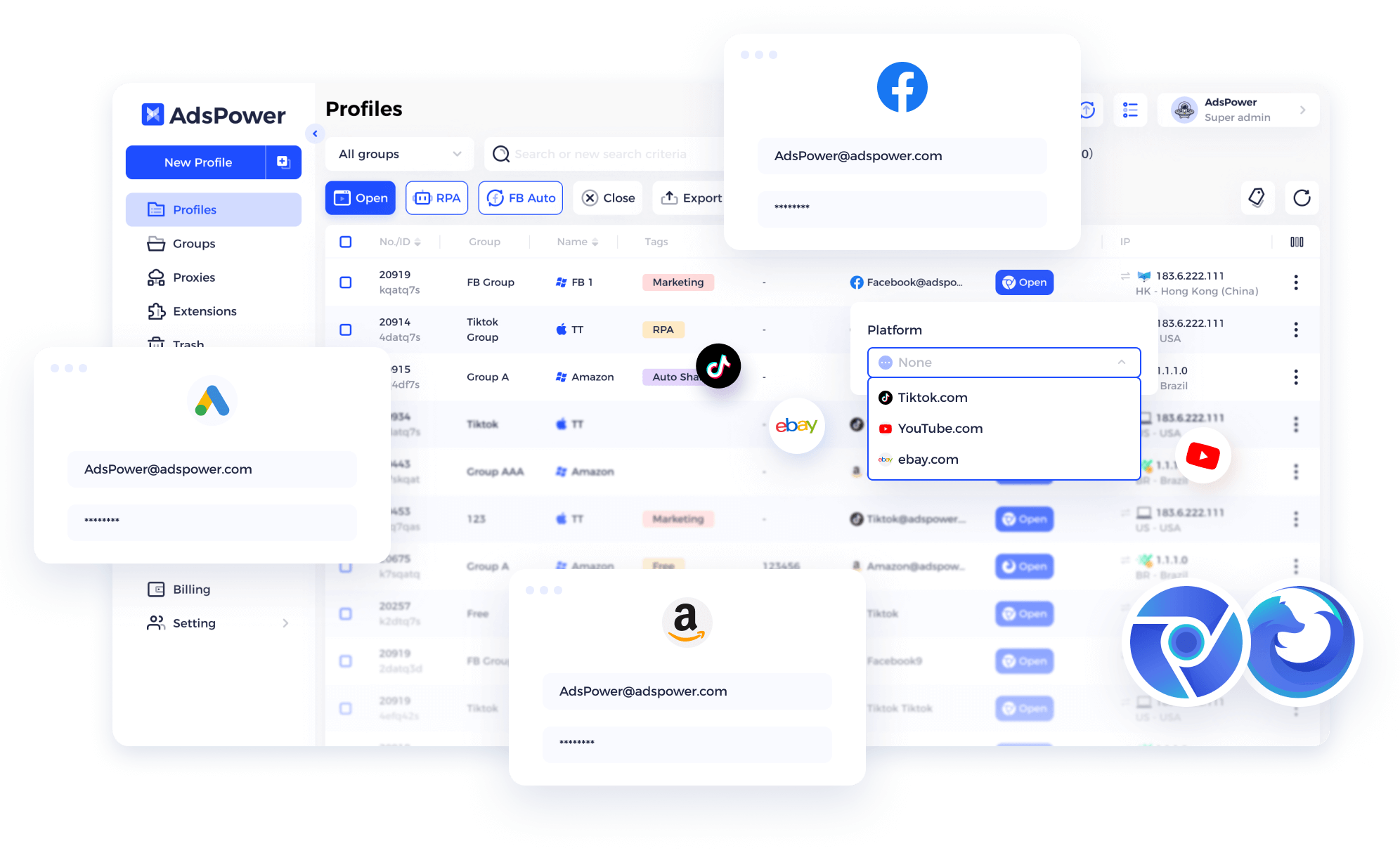
AdsPower vs Indigo: Which Anti-Detect Browser Wins? - What each browser actually is.
AdsPower in one paragraph
AdsPower is an anti-detect browser built for multi-accounting. It creates isolated browser profiles, each with a unique fingerprint, so you can run hundreds of accounts from one device without triggering bans. It ships two stealth browsers, SunBrowser and FlowerBrowser, with customizable fingerprints across Canvas, WebGL, network, and user agent parameters. The platform is trusted by over 10 million users and holds SOC 2 Type II, ISO 27001, and ISO 27701 certifications. Its core value proposition is cost reduction (no need for multiple physical devices), efficiency through batch operations, and account safety through advanced fingerprinting. Industries using it include e-commerce, affiliate marketing, social media marketing, web scraping, crypto, and online betting.
Indigo in one paragraph
Indigo is an antidetect browser designed for multi-accounting, traffic arbitrage, web scraping, bonus hunting, bounty and airdrop activities, e-commerce, digital agencies, and anonymity. It provides isolated browser profiles, proxy support, cookie management, and automation capabilities. It includes two browser cores, Stealthfox 146 and Mimic 148, and maintains a regularly updated fingerprint database. Indigo positions itself as a tool for becoming anonymous and managing multiple accounts without detection. It offers a free trial and paid licenses, with pricing, a knowledge base, and technical support available. Its website targets Russian- and English-speaking users, with a focus on affiliate marketing, e-commerce, and web data extraction professionals.
Head-to-head comparison

AdsPower vs Indigo: Which Anti-Detect Browser Wins? - Head-to-head comparison.
| Dimension | AdsPower | Indigo |
|---|---|---|
| Browser cores | SunBrowser and FlowerBrowser | Stealthfox 146 and Mimic 148 |
| Fingerprint control | Canvas, WebGL, network, user agent parameters | Fingerprint database, regularly updated |
| Profile isolation | Yes, isolated profiles with unique fingerprints | Yes, isolated browser profiles |
| Proxy support | Yes, proxy configuration per profile | Yes |
| Cookie management | Included in profile data | Yes |
| Automation | Built-in automation tools, no-code friendly | Automation capabilities |
| Team features | Role-based access, scalable profile counts | Not a headline feature in the product context |
| Cross-device sync | Yes | Not highlighted in the product context |
| Security credentials | SOC 2 Type II, ISO 27001, ISO 27701 | Not specified in the product context |
| Free entry | Free plan plus 7-day free trial | Free trial |
| Pricing tiers | Free, Professional, Business, Enterprise | Paid licenses |
| Primary audience | E-commerce, affiliate, SMM, scraping, crypto, betting | Affiliate, e-commerce, scraping, arbitrage, airdrops |
Fingerprint depth and anti-detection quality
Fingerprint depth is where the two products diverge most in practice.
AdsPower lets you customize fingerprints across Canvas, WebGL, network, and user agent parameters, and it encrypts profile data. That breadth matters when you are running profiles across different platforms that check different signal families. A social platform may lean on Canvas and WebGL entropy, while an e-commerce marketplace may weight network and user agent consistency more heavily. Having all four under one control panel reduces the number of places you have to patch manually.
Indigo takes a database-driven approach. It maintains a regularly updated fingerprint database and pairs it with two cores, Stealthfox 146 and Mimic 148. A maintained database can be a real advantage for anonymity-focused tasks because you are not hand-tuning every parameter. The trade-off is transparency: the product context does not describe per-parameter control the way AdsPower does, so if you need to prove exactly which fingerprint values a profile is presenting, AdsPower gives you more to inspect and adjust.
For a broader look at how fingerprint spoofing is evaluated across tools, see our Detect Expert review, which covers VM-level fingerprinting and setup difficulty.
Browser cores: SunBrowser and FlowerBrowser vs Stealthfox 146 and Mimic 148
Both products ship two cores, which is a sensible design: you can match the engine to the platform you are targeting rather than forcing one engine everywhere.
- AdsPower offers SunBrowser and FlowerBrowser. The pairing gives you flexibility when a target platform behaves differently depending on engine characteristics.
- Indigo offers Stealthfox 146 and Mimic 148. The version numbers in the names are useful because they tell you which engine generation you are working with.
Neither approach is automatically better. What matters is update cadence. If a core falls behind the current stable release of the underlying engine, detection systems that check version consistency will notice. Ask both vendors how often their cores are refreshed before you commit to an annual plan.
Automation and scaling
This is the clearest dividing line.
AdsPower includes batch profile management and automation tools, and it is positioned as a no-code-friendly platform. If your workflow involves creating profiles in bulk, assigning proxies in bulk, and running repetitive actions across many accounts, that is exactly the design goal. The company also supports teams with role-based access and scalable profile counts, which means an agency can give a contractor access to a subset of profiles without exposing the whole workspace.
Indigo provides automation capabilities and cookie management, but the product context does not describe a no-code builder or team permission system. For script-driven workflows, that may be fine. For an agency onboarding non-technical staff, it is a gap worth testing during the trial.
If you want to see how AdsPower fits into a cloud automation stack, our guide on using AdsPower with Browserbase walks through setup and practical workflows.
Team collaboration and cross-device work
Multi-accounting is rarely a solo activity at scale. Someone creates profiles, someone else runs them, and a third person handles proxies.
AdsPower addresses this with role-based access and cross-device sync, so a profile created on one machine can be picked up on another. That reduces the friction of distributed teams and makes handoffs less error-prone.
Indigo's product context emphasizes anonymity and profile isolation rather than collaboration tooling. That is not a flaw if you work alone or in a very small group, but it is a real limitation if you are coordinating across time zones.
Pricing and total cost
AdsPower offers four tiers: Free, Professional, Business, and Enterprise, plus a 7-day free trial. The free plan lowers the barrier for testing, and the tiered structure lets you scale profile counts as you grow. For a cost comparison against other tools in the same category, see our breakdown of AdsPower vs Octo vs Maskfog.
Indigo offers a free trial and paid licenses, with pricing available on its site. The product context does not specify tier names or profile limits, so you will need to check current pricing directly.
When you calculate total cost, include more than the subscription:
- Proxy spend. Both tools support proxies, and residential or mobile proxies usually cost more than the browser itself.
- Device replacement. AdsPower's core pitch is eliminating extra devices. If you would otherwise buy three laptops to run three account clusters, that saving is substantial.
- Labor. No-code automation can replace hours of manual clicking. Price that against any learning curve for script-based automation.
- Incident cost. A ban on a high-value ad account costs far more than a year of either subscription.
Security and compliance
AdsPower holds SOC 2 Type II, ISO 27001, and ISO 27701 certifications. For agencies handling client accounts, those certifications are not marketing decoration; they are evidence that an independent auditor has reviewed controls around security and privacy management. If you need to answer a client security questionnaire, this shortens the process considerably.
Indigo's product context does not list comparable certifications. That does not mean Indigo is insecure, but it does mean you cannot cite third-party attestation during procurement. If your clients or partners require documented compliance, verify what Indigo can provide before signing.
It is also worth understanding the threat model. Anti-detect browsers are dual-use tools, and security researchers have documented how tampering browsers can be abused for account takeover by replaying stolen cookies and cloned fingerprints. The practical takeaway for legitimate operators is that server-side device intelligence is getting stronger, so fingerprint consistency and profile hygiene matter more than ever. Fingerprint's analysis of client-side vs server-side fingerprinting explains why front-end-only spoofing is increasingly insufficient.
Use-case decision guide
E-commerce and marketplace sellers
AdsPower. Batch profile management, proxy configuration per store, and team roles map directly onto running multiple seller accounts. Indigo can work, but the collaboration layer is thinner.
Affiliate marketing and traffic arbitrage
Both are viable. Indigo explicitly targets arbitrage and bonus hunting, and its maintained fingerprint database suits high-volume, short-lived profiles. AdsPower's automation is better if you are running long-term campaigns with repeatable actions.
Social media marketing agencies
AdsPower. Role-based access and cross-device sync are hard requirements when multiple staff touch the same client accounts. See our guide to selling social media accounts safely for related transfer and safety considerations.
Web scraping and data extraction
Both support it. If you are scraping at scale, weigh automation depth and API access more heavily than fingerprint cosmetics. Our overview of Scrapingdog ecommerce scraping covers proxy and anti-bot handling that pairs with either browser.
Crypto, airdrops, and bounty hunting
Indigo lists bounty and airdrop activity as a target use case, so it is a natural fit. AdsPower covers crypto among its industries and adds certifications that may matter if you handle anything client-facing.
Privacy-first individual users
Indigo. If your goal is anonymity rather than account farming, its positioning aligns with that, and you may not need AdsPower's team and automation layers.
How to run a fair trial
Do not decide from feature lists. Run a structured test:
- Pick three target platforms that matter to you, ideally one strict and two moderate.
- Create five profiles in each browser with equivalent proxy types.
- Run the same actions for two weeks: logins, browsing, and any posting or purchasing behavior.
- Check fingerprint consistency with a fingerprint testing site at the start and end of the period.
- Log friction: CAPTCHAs, verification prompts, forced logouts, and any account warnings.
- Compare cost per surviving profile, not cost per subscription.
This method exposes the differences that marketing pages hide, especially around long-session stability.
Related reading
- Top 10 Online Privacy & IP Intelligence Tools 2026 - Independent 2026 ranking of the top 10 online privacy and IP intelligence tools, scored on IP data, fingerprinting, leaks, proxies, and API depth.
Sources and further reading
- 10 Best Antidetect Browsers for USA Residents - The following report examines the ten best antidetect browsers in the US market in 2026, how they differ, and where each performs best.
- Best AdsPower Alternatives in 2026 - Top 10 AdsPower alternatives in 2026: a review of features and pricing across different anti-detect browsers.
FAQ
Is AdsPower better than Indigo?
It depends on your workload. AdsPower is stronger for team collaboration, no-code automation, cross-device sync, and documented compliance. Indigo is a reasonable choice for anonymity-focused, script-driven, or arbitrage-heavy work where a maintained fingerprint database and two cores are enough.
Does Indigo have a free plan?
Indigo offers a free trial and paid licenses. AdsPower offers a free plan plus a 7-day free trial, so the entry points differ.
Which browser has better fingerprint spoofing?
AdsPower exposes customizable fingerprints across Canvas, WebGL, network, and user agent parameters. Indigo relies on a regularly updated fingerprint database. AdsPower gives you more manual control; Indigo gives you more automation of the fingerprint layer itself. Test against your own targets to see which performs better for you.
Can I use both browsers at the same time?
Yes. Some operators split workloads: one browser for high-value long-term accounts and another for high-volume, short-lived profiles. Just keep proxies and profile data strictly separated so you do not create linkage between identities.
What browser cores does each use?
AdsPower uses SunBrowser and FlowerBrowser. Indigo uses Stealthfox 146 and Mimic 148.
Is AdsPower safe for client work?
AdsPower holds SOC 2 Type II, ISO 27001, and ISO 27701 certifications and encrypts profile data, which supports client security reviews. Indigo's product context does not list equivalent certifications, so verify directly if compliance documentation is required.
Conclusion
AdsPower and Indigo solve overlapping problems with different priorities. AdsPower is the broader platform: two stealth browsers, customizable Canvas, WebGL, network, and user agent fingerprints, batch operations, no-code automation, role-based team access, cross-device sync, and audited security certifications. Indigo is the more focused anonymity tool: two cores in Stealthfox 146 and Mimic 148, a maintained fingerprint database, proxy and cookie management, and automation, aimed at arbitrage, scraping, airdrops, and privacy-conscious users.
If you run accounts as a business with staff, clients, and compliance questions, AdsPower's structure will save you time and reduce risk. If you run accounts as an individual focused on anonymity and volume, Indigo may cover your needs at a lower commitment. Either way, run the two-week trial described above before you pay, and judge the tools on surviving profiles rather than feature checklists.


