
Scrapingdog Review: Reliable Web Scraping API for Developers?
Take a Quick Look
In-depth Scrapingdog review covering speed tests, pricing, dedicated APIs, setup, and ideal use cases for SEO, e-commerce, and AI teams.
🔥 Limited-Time Offer! Save extra 10% off on your first monthly plan with code: Anitdetect10
Sign upScrapingdog Review: Fast, Reliable Web Scraping API for Developers
Scrapingdog positions itself as an all-in-one web scraping API that handles proxies, headless browsers, and CAPTCHAs behind a clean endpoint. In a market crowded with tools that overpromise and underdeliver on tough targets like Google SERPs, Walmart product pages, and JavaScript-heavy sites, developers want to know: does Scrapingdog actually deliver consistent performance at a fair price? This review digs into the API’s core features, dedicated scrapers, real-world speed and success rates, pricing structure, setup complexity, and the types of projects where it shines—helping you decide if it’s the right scraping layer for your next application.
What Is Scrapingdog?
Scrapingdog Review: Reliable Web Scraping API for Developers? product interface and feature overview.
Scrapingdog is a cloud-based web scraping platform that exposes a simple REST API for extracting structured data from websites. Instead of maintaining a rotating proxy fleet, browser clusters, and anti-detection workarounds yourself, you send a URL or search query to Scrapingdog and get back clean JSON (or HTML/Markdown). The service was built by developers who were tired of fighting infrastructure, and the product reflects that: over 1,000 companies use it, and its Trustpilot rating sits at 4.7 out of 5 stars.
Beyond a generic web scraping endpoint, Scrapingdog ships dedicated APIs for specific platforms—Google SERPs, Google Maps, social networks (TikTok, YouTube, LinkedIn), and major e-commerce sites like Amazon and Walmart. This specialization allows the service to return pre-structured fields (product price, ASIN, review count, etc.) without requiring you to parse raw HTML. Recent additions even include an endpoint for scraping ChatGPT responses and an AI-mode scraper for Google’s evolving results.
Key Features of the Scrapingdog API
Scrapingdog Review: Reliable Web Scraping API for Developers? - supporting product research image 2.
Anti-Bot Bypass and Proxy Infrastructure
Scrapingdog’s core promise is to keep requests flowing without getting blocked. It rotates through over 40 million residential and datacenter IPs, uses fingerprint randomization, and mimics human-like request patterns. If a site throws a CAPTCHA, the platform solves it automatically in the background. For projects that need high-volume, sustained access to protected domains—like scraping Glassdoor job listings or Amazon product details daily—this auto-bypass eliminates a major point of failure. (For pure CAPTCHA-solving services, you might also compare Anti Captcha Review 2026.)
Real Browser Rendering
Many modern sites render content only after JavaScript execution. Scrapingdog runs every request through a headless Chrome cluster, so you get the same data a real user’s browser would see. Combined with custom headers and session management, this makes it possible to scrape dynamic single-page apps and e-commerce pages that heavily rely on client-side rendering.
Geotargeting and Session Management
Location-sensitive data—local search results, region-specific pricing, restricted content—requires IPs in the right country. Scrapingdog supports geotargeting via residential proxies in multiple countries. You can also persist sessions across requests, which is useful when a target website expects a cohesive browsing pattern across multiple pages.
Dedicated APIs for Popular Platforms
Instead of forcing you to write selectors for every new site, Scrapingdog offers pre-built endpoints that return structured data for several high-demand platforms.
Google SERP & Maps Scraping
The Google SERP API handles organic results, ads, featured snippets, People Also Ask boxes, and the newest AI Overviews/AI Mode results. SEO teams use it for rank tracking, competitor analysis, and training large language models on live search data. The Google Maps API extracts business details, reviews, photos, and posts—a critical building block for local SEO tools like those used by AdsPower customers.
E-commerce Scrapers (Amazon, Walmart, eBay)
For price intelligence and marketplace analytics, Scrapingdog’s e-commerce endpoints return product titles, pricing, ASIN/seller IDs, ratings, stock status, and category breadcrumbs. The dedicated scrapers are pre-configured to handle each site’s anti-bot measures and HTML structure, so a single API call retrieves a ready-to-use JSON object.
Social Media & AI Scraping
Scrapingdog supports scraping public data from TikTok, X (Twitter), YouTube, and LinkedIn, with dedicated documentation for each network. For AI and LLM projects, the platform can directly output Markdown or clean JSON suitable for model context windows, and its ChatGPT scraper captures responses from the conversational interface.
Performance and Reliability Tested
To cut through marketing claims, we looked at published benchmark data that tested Scrapingdog alongside ScraperAPI and Scrapingbee on five target sites: Amazon, Glassdoor, eBay, Walmart, and Google.
Speed and Success Rate Benchmarks
In those tests, Scrapingdog achieved a 100% success rate on every domain—including notoriously difficult targets like Glassdoor and Google—while maintaining average response times between 4 and 6 seconds for most e-commerce pages and a staggering 1.25 seconds for Google SERPs. Here’s how that compares based on the published data (see Scrapingdog’s performance test):
| Provider | Amazon (1000 req) | Glassdoor (1000 req) | eBay (1000 req) | Walmart (1000 req) | Google SERP (1000 req) |
|---|---|---|---|---|---|
| Scrapingdog | 100% / 5.48 s | 100% / 5.57 s | 100% / 5.91 s | 100% / 4.48 s | 100% / 1.25 s |
| ScraperAPI | 100% / 40.65 s | 100% / 20.48 s | 100% / 8.28 s | 100% / 18.89 s | 80% / 27.25 s |
| Scrapingbee | 100% / 4.96 s | 0% / 4.99 s | 100% / 8.98 s | 40% / 7.35 s | 90% / 16.28 s |
Scrapingdog was the only API to maintain 100% success across all domains. ScraperAPI succeeded everywhere except Google (80%), but was significantly slower—up to 40 seconds on Amazon. Scrapingbee failed entirely on Glassdoor (0%) and delivered poor results on Walmart (40%). This consistency is what sets Scrapingdog apart for projects that can’t tolerate gaps in data coverage.
Real-World Performance Data
User reviews on Trustpilot echo these findings. Developers praise the API’s predictability, with one noting “100% success rate on the tests that I have done,” and another using it for Google Maps reviews with “perfectly” working results. The platform’s commitment to only charging for successful requests (failed ones don’t consume credits) further reduces risk when scraping unpredictable targets.
Pricing: Flexible Plans for Every Scale
Scrapingdog’s pricing starts with a free tier (200 credits/month) to test the service without a credit card. After that, it scales across 27 plans, from small side projects to enterprise workloads. A popular starting point is the $40/month Premium plan, which offers 200,000 API credits. At that tier, the per-call cost drops to around $0.0002, and costs can go below $0.000063 at high volume. For comparison, the same test data showed Scrapingbee’s Business+ plan at $0.0748 per 1k calls and ScraperAPI’s Scaling plan at $0.095 per 1k—Scrapingdog’s $0.058 per 1k was the most budget-friendly at scale.
Notably, there are no hidden infrastructure costs. You pay per successful request, no extra charges for proxy rotation, JavaScript rendering, or CAPTCHA solving. For teams that previously managed their own proxy pools—costs that often spiral with dedicated IPs and bandwidth—this provides a predictable operational expense. (If you still need standalone residential or ISP proxies for tasks like multi-accounting, the Proxy-Seller Review covers a different kind of solution.)
Ease of Setup and Developer Experience
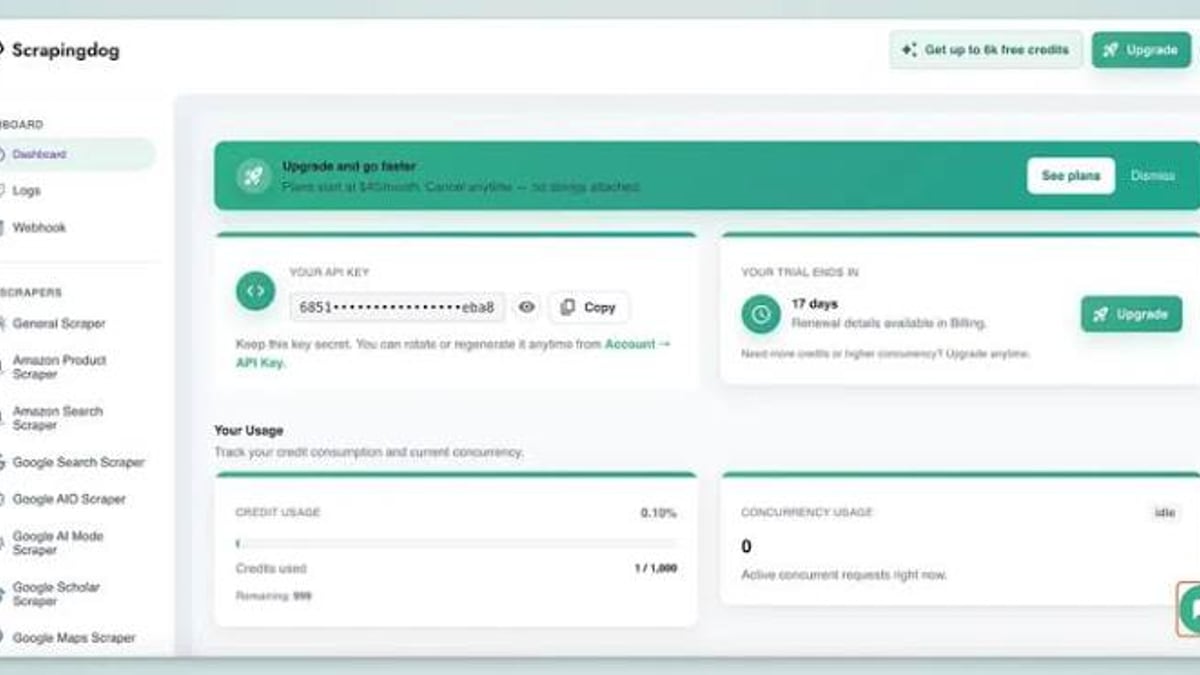
Scrapingdog’s documentation is thorough and designed to get you from signup to the first successful call in minutes. A typical Python integration looks like this:
import requests

api_key = "YOUR_API_KEY"
url = "https://api.scrapingdog.com/scrape"
params = {
    "api_key": api_key,
    "url": "https://www.example.com",
    "render": "true"
}
response = requests.get(url, params=params)
print(response.json())
The platform also offers dedicated libraries for Node.js, PHP, and Ruby, plus a Google Sheets add-on that lets non-coders pull scraped data directly into a spreadsheet—a handy bridge for marketing and sales teams.
Video tutorials, blog posts, and 24/7 chat support round out the developer experience. The API supports POST requests for complex payloads, custom headers, and the ability to return data in HTML, JSON, or LLM-friendly Markdown formats.
Ideal Use Cases for Scrapingdog
Scrapingdog Review: Reliable Web Scraping API for Developers? - supporting product research image 3.
SEO and SERP Monitoring
Scrapingdog’s lightning-fast Google scraper makes it ideal for rank-tracking tools. Because it handles geotargeting and returns structured SERP fields (including ads and featured snippets), you can build a robust SEO dashboard without worrying about detection. AdsPower users who need reliable, programmatic access to search results can plug the API directly into their monitoring pipelines.
Price Intelligence and Competitive Analysis
Amazon, Walmart, and eBay endpoints let you track competitor prices, monitor stock levels, and detect MAP violations at scale. The structured JSON output removes the need for post-processing, and the consistent success rates on high-security domains mean you won’t lose critical daily snapshots.
AI Model Training Data Collection
Gathering diverse web text for LLM fine-tuning often requires scraping thousands of pages. Scrapingdog’s Markdown output strips irrelevant boilerplate and delivers clean content ready for tokenization. Its automatic retry and anti-bot capabilities ensure that crawls complete even when sites deploy aggressive blocking.
Lead Generation and Data Enrichment
Using the LinkedIn or profile scraper API, sales teams can extract public company data and decision-maker details for enrichment. The platform’s ability to handle session management and pagination simplifies building contact databases from professional directories.
Limitations and Considerations
Scrapingdog excels at general and platform-specific scraping, but it’s not a one-size-fits-all tool. Here are a few points to weigh:
- No built-in data storage or scheduling: The API returns data; you need your own pipeline to store and process it. This is standard among scraping APIs, but teams looking for an end-to-end solution will need to add a database and scheduler.
- Support channels are primarily email and chat: While response times are reportedly fast, there’s no phone line—something to consider if you need 24/7 escalation paths.
- Complex, stateful sites may require advanced configuration: Although JavaScript rendering is built in, truly complex workflows (e.g., multi-step logins, infinite scroll with filters) might need combination with a browser automation tool.
- Competitive landscapes change: A dedicated endpoint for a platform like LinkedIn can break if the site updates its anti-bot measures. Scrapingdog’s team actively maintains these scrapers, but any external dependency carries that risk.
Scrapingdog vs. Other Web Scraping APIs
Scrapingdog Review: Reliable Web Scraping API for Developers? - supporting product research image 4.
Compared to the vintage players like ScraperAPI and Scrapingbee, Scrapingdog consistently wins on speed and success rate while undercutting them on price. Where ScraperAPI offers a huge proxy pool but slower response times, Scrapingdog balances thorough anti-bot measures with rapid page loading. Scrapingbee is developer-friendly but couldn’t handle Glassdoor or Walmart reliably in independent tests. For a broader view of alternatives, our Top 10 Web Scraping API & RPA Platforms 2026 guide breaks down the entire landscape, including tools that pair well with scraping for automation tasks.
Related reading
- How to Use AdsPower Fingerprint Browser for Amazon Seller Central - Step-by-step guide to using AdsPower antidetect browser with Amazon Seller Central. Safely manage multiple seller accounts, avoid suspensions, and automate workflows.
- AdsPower vs GoLogin vs Genlogin: 2026 Anti-Detect Browser Comparison - Compare AdsPower, GoLogin, and Genlogin anti-detect browsers across fingerprinting, automation, pricing, and team features to find the best tool for multi-account management.
Sources and further reading
- Scalable Web Scraping API for Data Extraction | Scrapingdog - Scrapingdog is your all-in-one Web Scraping API, effortlessly managing proxies and headless browsers, allowing you to extract the data you need with ease.
Frequently Asked Questions (FAQ)
Does Scrapingdog offer a free trial?
Yes. New users get 200 free credits monthly with no payment card needed. This is enough to run several test scrapes and evaluate the API before committing.
What happens when a request fails?
You aren’t charged for failed requests. Scrapingdog automatically retries with different proxies and configurations; if it ultimately can’t retrieve the data, the credit is refunded.
Can I scrape behind login walls or with custom headers?
Yes. The API supports setting custom headers, cookies, and session handling. For logged-in sessions, you can pass the necessary credentials/tokens.
Is Scrapingdog compliant with GDPR and other regulations?
Scrapingdog only provides the technology; it’s your responsibility to ensure your scraping targets comply with applicable laws and site terms of service. The platform doesn’t store scraped data—it passes it directly to you.
Does Scrapingdog have a Google Sheets integration?
Yes. Their Sheets add-on lets you pull data directly into a spreadsheet without writing code, which is handy for quick lists and non-technical team members.
Final Verdict: Is Scrapingdog Right for You?
Scrapingdog delivers what it promises: a fast, reliable web scraping API that abstracts away proxies, browsers, and CAPTCHAs. Its dedicated endpoints for Google, Amazon, social media, and more turn complex scraping targets into simple API calls. With a 100% success rate across major domains in published tests, response times as low as 1.25 seconds on Google, and a pricing model that rewards scale, it’s a strong choice for SEO tools, e-commerce analytics, and AI data pipelines.
However, the platform works best as a data retrieval layer—you’ll still need to build the storage, scheduling, and analysis components yourself. For teams that have those pieces in place and are tired of fighting blocks, Scrapingdog is one of the most capable scraping APIs available today.
If your project demands bulletproof data extraction without building and maintaining a scraping stack, start with Scrapingdog’s free credits and run your own tests against the sites that matter most.