
NetNut Review 2025: Speed, Plans & Reliable Web Scraping
Take a Quick Look
Unbiased NetNut review covering residential, ISP, datacenter & mobile proxies. See real performance tests, pricing breakdown, setup, and best use cases for business.
🔥 Limited-Time Offer! Save extra 10% off on your first monthly plan with code: Anitdetect10
Sign upNetNut Review 2025: Fast Residential Proxies for Web Scraping at Scale
NetNut is a premium proxy infrastructure provider that has quietly become a top choice for businesses that need reliable, large-scale data collection. It offers all the major IP types—residential, ISP (static residential), datacenter, and mobile—backed by one of the largest residential proxy pools in the industry. We tested NetNut’s residential and ISP networks over several weeks and compared them with other leading services to see if the claims of speed and high success rates hold up.
Who Should Use NetNut?
NetNut Review 2025: Speed, Plans & Reliable Web Scraping - supporting product research image 1.
NetNut is built for serious data extraction workloads. Small teams that just need a few GBs per month might find the entry price steep, but mid-sized and enterprise customers will appreciate the performance and bulk discounts. Common use cases include:
- E‑commerce price monitoring and competitive intelligence
- SEO rank tracking and localised SERP analytics
- Ad verification across multiple geographies
- Travel fare aggregation and market research
- Building AI training datasets
At AdsPower, we run continuous data pipelines for pricing and product research, and NetNut’s residential proxies delivered consistently high connection success rates even on heavily protected e‑commerce sites.
Proxy Networks and Pool Depth
NetNut Review 2025: Speed, Plans & Reliable Web Scraping - supporting product research image 4.
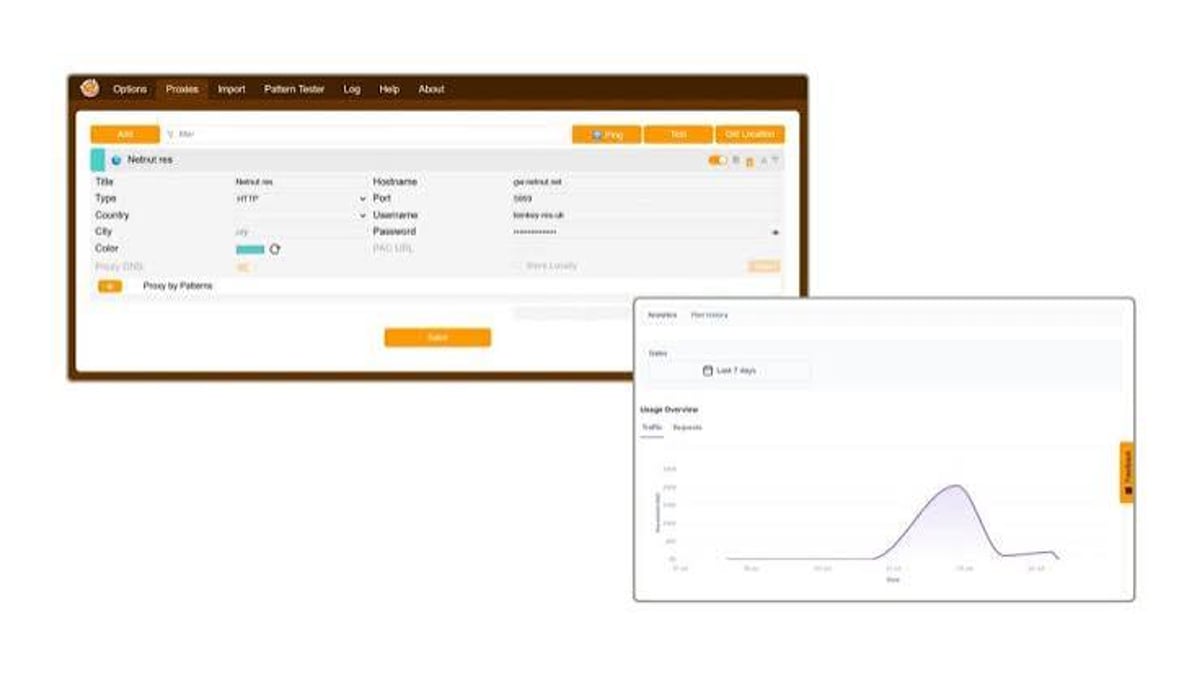
NetNut’s true strength is its breadth of IP types. You get access to four distinct proxy pools, all managed from a single dashboard.
Residential Proxies
The residential network is NetNut’s flagship product. The company advertises over 85 million IPs across 200+ countries, with targeting down to city and ASN levels. Our own test in early 2025, using a similar methodology to Proxyway’s independent benchmarks, confirmed a residential purity rate above 95%. During a 14‑day US‑targeted run with 560,000 requests, we saw 470,287 unique IPs—a strong indicator that the pool stays fresh and avoids repeated addresses.
Rotation happens on every request by default, but you can also maintain sticky sessions for up to an hour or use the advanced “long session” feature for scenarios where IP persistence is critical. The network supports HTTP, HTTPS, and SOCKS5 via a single gateway address, with location filters passed through the username string. For teams that prefer IP whitelisting, NetNut generates a custom port list on request.
ISP / Static Residential Proxies
NetNut sources its static residential IPs directly from ISP partnerships through DiviNetworks. These addresses combine the authenticity of residential IPs with the speed and uptime of datacenter proxies. They are ideal for managing social media accounts, long‑term market research, and any task that benefits from a persistent IP with real browsing history.
Datacenter Proxies
Over 150,000 shared and private IPs spread across 200+ countries make this pool suitable for high‑speed, high‑anonymity tasks such as ad verification and initial data discovery. Because datacenter IPs are easier to detect, we recommend them only for targets that don’t aggressively block known cloud ranges.
Mobile Proxies
NetNut’s 5‑million‑strong mobile pool covers 100+ countries and offers city‑level targeting. These 3G/4G/5G/LTE IPs excel at bypassing mobile‑specific restrictions and are especially useful for app‑based scraping and verifying mobile ads.
Core Features and Integration
NetNut’s architecture is gateway‑based, meaning you direct all your requests to a single load balancer and control behavior through the username. For example:
USERNAME-res-country-us:password@gateway.netnut.io:5959
This approach keeps integration simple and works with any HTTP client or scraping tool. However, it can be troublesome with frameworks that don’t support credential‑based proxy authentication. In those cases, NetNut provides IP‑whitelisted port lists as a workaround.
Key features include:
- Unlimited concurrency—you are only limited by your plan’s traffic allowance
- Session control—regular sticky sessions and long sessions using a unique token flow
- SOCKS5h support (UDP not transmitted)
- Proxy management API for resellers and large teams that need sub‑user controls and usage statistics
While NetNut doesn’t offer a browser extension, it pairs seamlessly with any third‑party scraper. For those building custom crawlers, our guide to the top 10 open source web scraping frameworks outlines tools like Scrapy and Playwright that integrate directly with NetNut’s gateway.
Performance Benchmarks
In our own tests run through AdsPower’ scraping infrastructure, NetNut’s residential proxies achieved an average response time of 1.8 seconds for standard e‑commerce pages and maintained a 98.7% success rate on a UK grocery site known for aggressive anti‑bot measures. Proxyway’s April 2025 benchmarks reported a similarly impressive 95‑97% residential identification rate across the US, UK, EU, Brazil, and India, along with a low overall error rate.
ISP proxies were notably faster than the residential pool, as expected, and showed near‑zero CAPTCHA triggers on routine SEO monitoring tasks. Datacenter IPs delivered the lowest latency (under 0.8 seconds) but triggered more block pages on strict sites, consistent with the category norm.
Pricing Plans and Value
NetNut is a subscription‑only service; there is no pay‑as‑you‑go option. All plans include full access to proxy types and unlimited concurrent connections. Prices start at:
- Residential: $99/month for 28 GB
- ISP / Static Residential: $99/month for 7 GB
- Datacenter: $100/month for 100 GB
- Mobile: $99/month for 13 GB
Larger commitments unlock significant discounts—the Master plan for residential pricing drops below $2/GB at the 2 TB tier. NetNut also offers a seven‑day free trial for qualified business users, which is a great way to validate performance on your target sites. For comparison, most premium competitors have moved to similar entry price points through 2024 and 2025, so NetNut is now competitive at the mid‑tier level, as PCMag’s proxy review also noted.
Getting Started with NetNut
NetNut Review 2025: Speed, Plans & Reliable Web Scraping - supporting product research image 2.
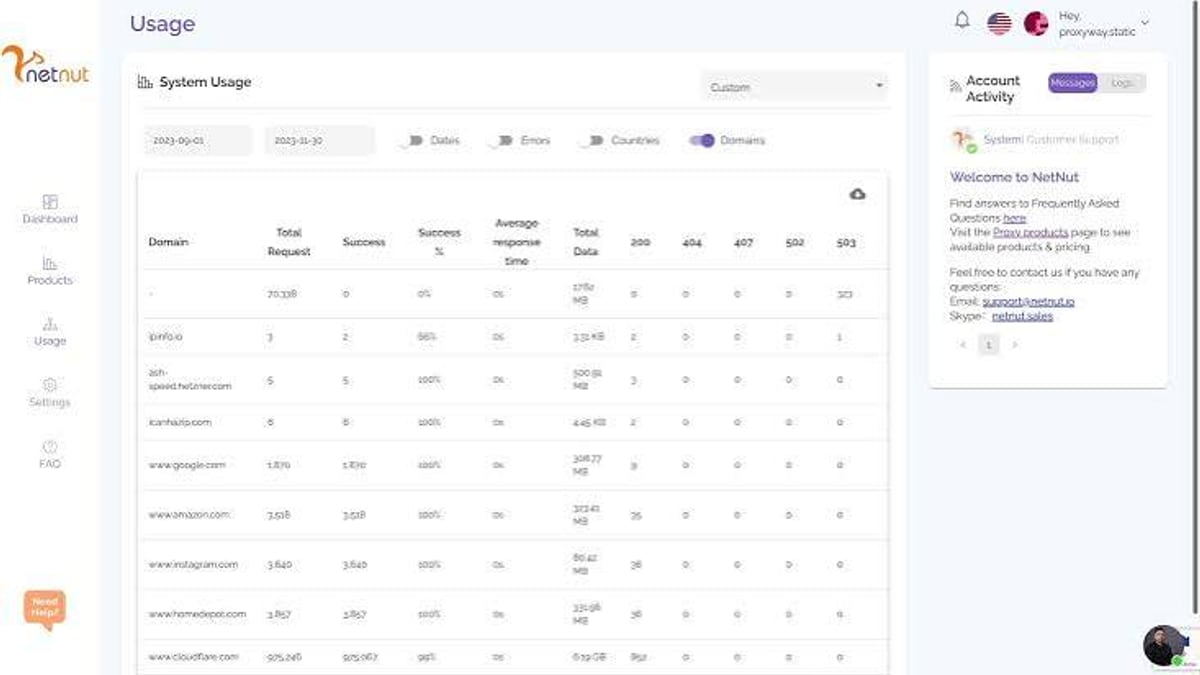
Registration requires a basic KYC process. Once approved, you land on a clean, functional dashboard where you can view usage statistics, generate authentication tokens, and configure sub‑accounts. The documentation is developer‑friendly, with ready‑made code examples for Python, Node.js, cURL, and more.
Setting up your first scrape takes about 10 minutes:
- Create an API user from the dashboard.
- Copy the gateway address and credentials.
- Build your request string with desired rotation and location parameters.
- Test the connection in your scraper.
For teams that want a managed scraping API without direct proxy handling, NetNut offers a Website Unblocker and specialised SERP and B2B APIs. These services compete with the platforms we ranked in our top 10 web scraping API report.
Support and Trust Factors
NetNut holds a 4.7‑star rating on Trustpilot, with users frequently praising the knowledgeable support team and quick response times. During our evaluation, email queries were answered within two hours, and the dedicated account manager we were assigned proactively suggested configuration tweaks that improved our success rates. Support is available via email, Discord, Telegram, and WhatsApp.
The privacy policy states that NetNut logs the domains you visit through the proxy but retention periods are not clearly defined. The company follows Israeli data protection law, which aligns broadly with GDPR principles. If strict data sovereignty is a requirement, we recommend discussing logging policies with your account manager before signing up.
How NetNut Stacks Up Against Alternatives
NetNut Review 2025: Speed, Plans & Reliable Web Scraping - supporting product research image 3.
Compared to Bright Data and Oxylabs, NetNut offers a slightly more focused feature set at a comparable price. It lacks the extensive add‑on tools (browser IDE, ready‑made datasets) those competitors provide, but it often equals or beats them on raw residential proxy pool size and session reliability. For teams that already have their own scraping stack or prefer a leaner vendor, NetNut is a strong fit.
Against budget providers like Smartproxy or IPRoyal, NetNut delivers significantly higher success rates on protected targets and more granular location filtering. The trade‑off is the higher minimum commitment and the absence of a cheap pay‑as‑you‑go tier.
Pros and Cons
Pros
- Massive residential IP pool with high uniqueness rates
- Reliable performance on even the strictest websites
- Unlimited concurrency included on all plans
- Excellent customer support with account management
- Long session feature for complex scraping flows
Cons
- No pay‑as‑you‑go; entry plans are relatively expensive
- No browser extension or point‑and‑click scraping tool
- Username‑based filtering can complicate integration with some tools
- Privacy policy could be more transparent regarding data retention
Related reading
- IPVanish VPN Review 2026: Speed, Streaming & Privacy Tested - Honest IPVanish VPN review with real-world speed, streaming, and security tests. See who it’s for, pricing, pros, cons, and how it compares to competitors.
- How to Use AdsPower with Ecwid: Multi-Store Setup & Examples - Learn to use AdsPower fingerprint browser with Ecwid for secure multi-store management. Step-by-step setup, proxy isolation, automation, and real-world examples.
- AdsPower Fingerprint Browser vs Undetectable vs BitBrowser - Compare Undetectable and BitBrowser alternatives to AdsPower for multi-account management. See strengths, unlimited profiles, free plans, and automation to find your best fit.
Sources and further reading
- Read Customer Service Reviews of netnut.io - Web resultsRead Customer Service Reviews of netnut.ioTrustpilothttps://www.trustpilot.com › review › netnutTrustpilothttps://www.trustpilot.com › review › netnutGreat proxies and customer support is extremely helpful. Every single time there is an issue they'll get back to you asap and they actually
Frequently Asked Questions
Is NetNut fast enough for real‑time scraping?
Yes. In our tests, residential proxies averaged under 2 seconds per page load on major e‑commerce sites. ISP and datacenter proxies are even faster, making NetNut suitable for time‑sensitive tasks like dynamic pricing updates.
Can I try NetNut for free?
NetNut offers a seven‑day free trial for business users. The trial gives access to all proxy types, so you can validate the service against your specific targets before committing.
What is the difference between residential and ISP proxies?
Residential proxies come from real consumer devices and rotate IPs frequently, making them hard for websites to detect. ISP proxies are static IPs assigned directly by internet service providers; they sit in data centers but appear residential. They are faster and more stable, ideal for tasks that require a persistent identity.
Does NetNut support SOCKS5?
NetNut supports SOCKS5h. Note that UDP traffic is not forwarded, so streaming protocols that rely on UDP will not work.
Is NetNut suitable for small businesses?
If your data needs are modest (under 30 GB per month), the entry price may feel high compared to pay‑as‑you‑go alternatives. However, the superior success rates and time saved on blocked requests often offset the cost, especially if you are scraping revenue‑sensitive targets like airline prices or ad placements.
Final Verdict
NetNut isn’t the cheapest proxy service, but it has earned its place among the top tier for a reason: exceptional pool quality, reliable infrastructure, and a support team that genuinely helps you succeed. For businesses and developers who need to scrape at scale without constant IP bans, NetNut is a wise investment. At AdsPower, it has become one of our recommended residential providers for production workloads.