
Cross-Border E-Commerce: A Complete 2026 Guide
Take a Quick Look
Learn what cross-border e-commerce is, how it works, key benefits and challenges, market entry strategies, and tools for managing multi-market operations.
🔥 Limited-Time Offer! Save extra 10% off on your first monthly plan with code: Anitdetect10
Sign upCross-Border E-Commerce: A Complete Guide to Selling Internationally
Cross-border e-commerce is no longer reserved for multinational corporations. Today, a solo seller in Lisbon can ship handmade ceramics to a customer in Toronto, and a mid-sized brand in Ho Chi Minh City can sell directly to shoppers in Berlin without opening a single physical store. The internet has collapsed geographic barriers, but the operational complexity behind those transactions remains very real.
This guide explains what cross-border e-commerce actually involves, how it differs from domestic selling, where the biggest opportunities and risks lie, and how to build an international operation that scales without falling apart under regulatory, logistical, or technical pressure.
What Is Cross-Border E-Commerce?
Cross-Border E-Commerce: A Complete 2026 Guide - What Is Cross-Border E-Commerce?.
Cross-border e-commerce is any online transaction in which the buyer and seller are located in different countries. The sale can involve physical goods shipped across a border or digital products delivered instantly. What distinguishes it from domestic e-commerce is that the transaction crosses at least one international boundary, triggering customs, currency, tax, and compliance considerations that a purely local sale never encounters.
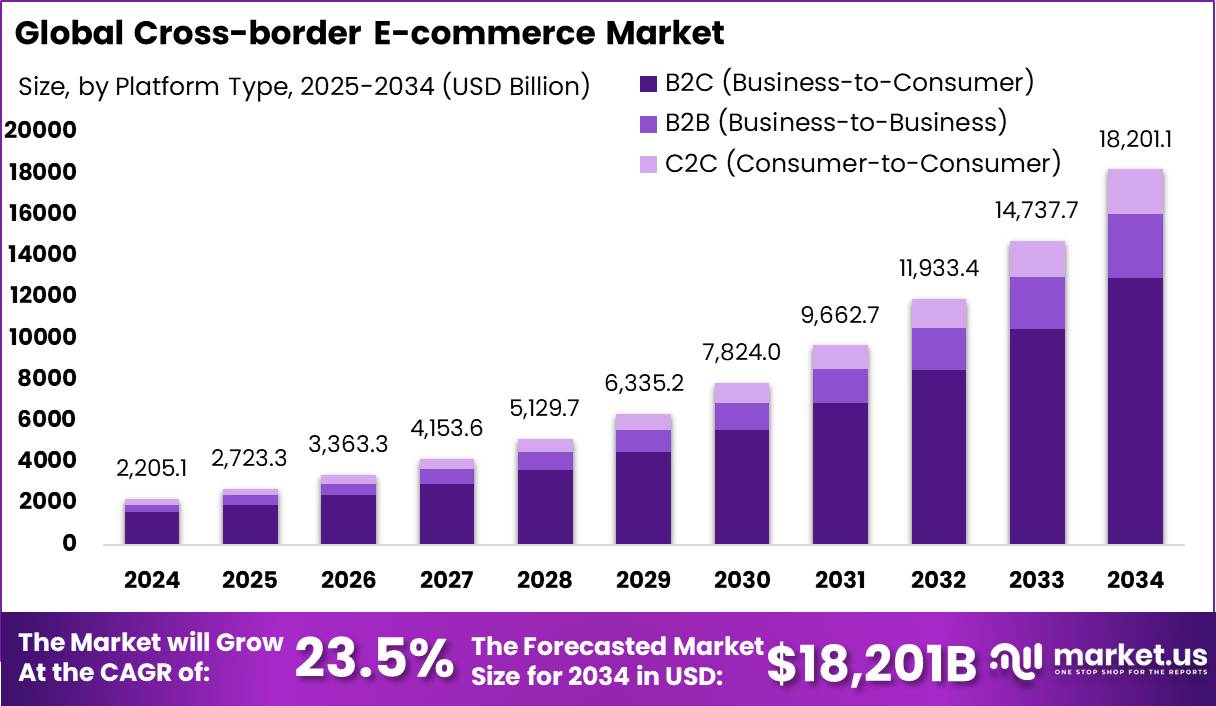
The scale of this market is significant. Global cross-border e-commerce value is projected to grow from roughly $551 billion in 2025 to $2 trillion by 2034, according to Stripe's analysis of cross-border business models. The World Customs Organization identifies four essential elements of cross-border e-commerce transactions: online initiation, a cross-border shipment, physical goods, and a consumer destination, typically B2C or C2C.
For many businesses, international selling is no longer a growth experiment. It is a core revenue strategy that reduces dependence on a single domestic economy and opens access to markets with different seasonal patterns, price sensitivities, and demand curves.
How Cross-Border E-Commerce Works
Cross-Border E-Commerce: A Complete 2026 Guide - How Cross-Border E-Commerce Works.
The mechanics vary by market, but most cross-border operations follow one of a few established models.
Direct Shipment from the Exporting Country
In this model, the seller receives an order through their own website or a marketplace, then ships the product directly from their home country to the buyer. This is the simplest entry point because it requires no foreign inventory or local entity. The trade-off is longer delivery times, higher per-unit shipping costs, and a greater likelihood of customs friction.
Bonded Warehouse Model
Some markets, notably China, allow imported goods to be stored in bonded zones before orders are placed. Once a customer buys, the goods clear customs from within the bonded warehouse and ship domestically. The EU SME Centre explains that this model lets sellers avoid pre-market product registration requirements that apply to general trade, while also benefiting from preferential tax rates on many product categories.
Local Fulfillment and Marketplaces
Sellers who reach meaningful volume in a market often shift to local fulfillment through third-party logistics providers or marketplace warehousing programs. Amazon FBA, for example, lets sellers store inventory in the destination country and offer domestic-speed delivery. This improves conversion but increases upfront investment and inventory risk.
Digital Products and Services
Not all cross-border commerce involves parcels. SaaS platforms, streaming services, online courses, and consulting engagements are all cross-border transactions when the customer pays from another country. These businesses skip physical customs entirely but still face payment, tax, and compliance complexity.
Benefits of Selling Across Borders
Cross-Border E-Commerce: A Complete 2026 Guide - Benefits of Selling Across Borders.
International expansion offers advantages that go beyond simply adding revenue.
Revenue diversification. A business that sells in five countries is less exposed to an economic downturn or regulatory shift in any single one. This is especially valuable for brands in smaller domestic markets.
Seasonal smoothing. Selling into both hemispheres balances demand. A swimwear brand can offset a slow domestic winter with summer sales in Australia or Brazil.
Premium positioning. In many markets, foreign brands carry prestige that supports higher price points than domestic competitors can command.
Economies of scale. Higher total volume reduces per-unit production and shipping costs, improving margins across the entire operation, including the home market.
Access to specialized talent and suppliers. Cross-border operations often lead to international supplier relationships and hiring opportunities that further strengthen the business.
Challenges That Derail Cross-Border Sellers

Cross-Border E-Commerce: A Complete 2026 Guide - Challenges That Derail Cross-Border Sellers.
The benefits are real, but so are the failure points. Understanding them before launch prevents expensive mistakes later.
Customs, Duties, and De Minimis Rules
Every country sets its own thresholds for duty-free imports, known as de minimis values. Shipments above those thresholds require formal customs declarations, duty payments, and sometimes additional taxes. The World Customs Organization notes that customs authorities worldwide are grappling with the shift from bulk shipments to millions of low-value parcels, and many are tightening enforcement on undervaluation and consignment splitting.
Payment Fragmentation
Shoppers in different countries prefer different payment methods. Cards dominate in the US and UK, but bank transfers are standard in Germany, iDEAL is essential in the Netherlands, and digital wallets lead in much of Asia. A checkout that only accepts Visa and Mastercard will lose conversions in markets where local methods are the default.
Currency and FX Risk
When you price in a foreign currency, exchange rate movements can erode margins between the time an order is placed and the time funds are settled. Pricing in your home currency shifts that risk to the buyer, which can hurt conversion. Most successful sellers use a mix of local-currency pricing and hedging strategies.
Tax and Compliance Complexity
Value-added tax, goods and services tax, digital services tax, and sales tax all vary by jurisdiction. The EU's Import One-Stop Shop scheme simplified VAT collection for many sellers, but compliance still requires accurate registration, collection, and remittance across multiple authorities.
Returns and Customer Support
International returns are expensive and logistically painful. A clear, localized returns policy is essential, as is multilingual support. Buyers who cannot get help in their own language or time zone will simply buy elsewhere.
Platform and Account Management Risk
Many cross-border sellers operate multiple storefronts across Amazon, eBay, Etsy, TikTok Shop, and regional marketplaces. Each platform has its own account policies, and managing several accounts from one device can trigger fraud detection systems that link accounts and issue bans. This is where dedicated browser profile management becomes operationally important. Tools like AdsPower create isolated browser environments with unique digital fingerprints, allowing sellers to manage separate marketplace accounts, regional storefronts, and advertising profiles without cross-account contamination. For teams running high-volume multi-market operations, this kind of account isolation is a practical safeguard rather than an optional extra.
Choosing Which Markets to Enter
Not every country is a good fit for every product. A structured evaluation prevents wasted investment.
Demand Validation
Start with data, not intuition. Look at search volume for your product category in target markets, existing competition on local marketplaces, and any sales you already receive from international customers. If you are already shipping to a country organically, that is a signal worth investigating.
Regulatory Feasibility
Some product categories face restrictions in specific markets. China's CBEC Positive List, for example, specifies which products can be sold through cross-border e-commerce channels. Cosmetics, food, supplements, and electronics often have additional labeling, certification, or testing requirements. Verify that your product can legally enter the market before investing in marketing.
Logistics and Fulfillment Costs
Calculate the true landed cost of shipping to each candidate market, including freight, duties, taxes, and any required local compliance. A product that is profitable to ship domestically may be uncompetitive internationally once all costs are included.
Payment and Currency Readiness
Confirm that your payment infrastructure supports the methods and currencies buyers in that market expect. If you cannot accept the dominant local payment method, conversion will suffer regardless of product quality.
Competitive Landscape
Assess whether you are entering a crowded market with entrenched local players or a gap where foreign brands have an advantage. In some categories, being an international brand is a differentiator. In others, local incumbents have structural advantages that are hard to overcome.
Cross-Border E-Commerce Models Compared
| Model | Setup Cost | Time to Market | Inventory Risk | Best For |
|---|---|---|---|---|
| Direct shipment from home country | Low | Fast | Low | Testing new markets, low-volume niches |
| Bonded warehouse | Medium | Medium | Medium | China market entry, regulated categories |
| Local fulfillment / 3PL | High | Slower | High | Established demand, high-volume SKUs |
| Marketplace FBA or equivalent | Medium | Medium | Medium | Brands wanting domestic-speed delivery |
| Digital products / SaaS | Low | Fast | None | Software, courses, streaming, services |
Building a Cross-Border Tech Stack
The right tools reduce operational friction at every stage of the international sales funnel.
Payments and Checkout
Choose a payment provider that supports multi-currency processing, local payment methods, and automated tax calculation. The goal is a checkout experience that feels local to the buyer while consolidating reporting for the seller.
Logistics and Customs
Work with carriers and freight forwarders that specialize in cross-border e-commerce. Look for providers that offer landed-cost calculation at checkout, electronic customs filing, and tracking that works across handoffs between carriers.
Multi-Account and Regional Operations
Running separate storefronts for different regions often means managing multiple seller accounts, ad accounts, and social media profiles. When these accounts are accessed from a single device without isolation, platforms may flag the activity as suspicious. Anti-detect browsers like AdsPower solve this by creating separate browser profiles, each with its own fingerprint, cookies, and proxy configuration. This is particularly relevant for sellers operating on marketplaces with strict one-account-per-entity policies or teams managing accounts for multiple brands across regions. For a detailed comparison of anti-detect browser options, see AdsPower vs RoxyBrowser vs Maskfog.
Automation and Scaling
As order volume grows, manual processes break down. Automation tools for listing management, repricing, order routing, and customer communication become essential. Teams managing dozens of marketplace accounts often pair browser profile management with RPA and API integrations to handle repetitive tasks across accounts without triggering platform security systems.
Cross-Border E-Commerce FAQ
What is the difference between cross-border e-commerce and general trade?
General trade typically involves bulk shipments, formal import documentation, and often a local entity or distributor. Cross-border e-commerce involves direct online sales to individual consumers, usually in smaller parcels, with simplified customs procedures in many markets. Some countries, like China, offer preferential tax treatment and reduced regulatory requirements for cross-border e-commerce compared to general trade.
Do I need a local company to sell internationally?
Not necessarily. Many marketplaces and payment providers allow sellers to operate from their home country without establishing a foreign entity. However, some markets or business models may require local registration, particularly for tax collection, certain product categories, or operating your own localized website.
How do I handle customs declarations for cross-border shipments?
Most carriers and fulfillment platforms provide electronic customs filing as part of the shipping process. You will need accurate product descriptions, HS codes, values, and country of origin for each item. Inaccurate declarations can lead to delays, fines, or seized shipments.
What is the de minimis threshold and why does it matter?
The de minimis threshold is the value below which imported goods are exempt from duties and taxes. Thresholds vary widely by country, from very low amounts in the EU to higher limits in markets like the US. Understanding these thresholds helps you price products competitively and communicate total costs to buyers.
How do I manage multiple marketplace accounts without getting banned?
Platforms detect linked accounts through shared IP addresses, browser fingerprints, cookies, and device identifiers. Using isolated browser profiles with unique fingerprints and dedicated proxy IPs for each account is a common approach among multi-account sellers. AdsPower is built specifically for this use case, offering batch profile management, proxy integration, and automation features for teams running accounts at scale.
What payment methods should I offer for international sales?
At minimum, offer major credit cards and PayPal or a comparable digital wallet. Beyond that, add local methods based on your target markets: iDEAL for the Netherlands, Bancontact for Belgium, Pix for Brazil, UPI for India, and Alipay or WeChat Pay for China. The more local the payment experience, the higher the conversion rate.
How do I handle international returns?
Offer a clear, localized returns policy that states who pays for return shipping, how refunds are processed, and the expected timeline. Many sellers use local return addresses or third-party return services in key markets to reduce costs and improve the customer experience.
Related reading
- How to Use AdsPower with PROXYS.IO: Full Setup Guide - Learn how to configure PROXYS.IO proxies inside AdsPower, verify IP anonymity, avoid account bans, and run stable multi-account workflows step by step.
- AdsPower vs RoxyBrowser vs Maskfog Antidetect Browsers: How to Choose in 2026? - Compare AdsPower, RoxyBrowser, and Maskfog antidetect browsers across fingerprint isolation, proxy integration, automation, team collaboration, and pricing to find the best anti-detection browser for multi-account operations.
- Cryptocurrency Prices Today: Live Charts, Market Data & Tracking - Track live cryptocurrency prices, market cap, volume, and trends for Bitcoin, Ethereum, Solana, and altcoins. Learn how to read crypto price data and track multiple assets efficiently.
Conclusion
Cross-border e-commerce is one of the most direct ways to expand your total addressable market without the capital intensity of physical international expansion. But it rewards preparation. Sellers who understand customs rules, localize payments and pricing, choose markets based on data rather than assumption, and build an operational stack that can handle multi-account complexity will consistently outperform those who treat international sales as an afterthought.
The businesses winning in this space are not necessarily the largest. They are the ones that treat each market as a distinct operation, respect local regulations and buyer expectations, and invest in the infrastructure, from payment processing to browser profile isolation, that keeps a multi-market operation stable and scalable.