
AdsPower vs Multilogin Homepage: Best Anti-Detect Browser?
Take a Quick Look
AdsPower vs Multilogin Homepage compared: pricing, fingerprints, automation, proxies, and security. See which anti-detect browser fits your multi-accounting workflow.
AdsPower vs Multilogin Homepage: Which Anti-Detect Browser Should You Choose?
If you manage dozens or hundreds of online accounts, the browser you pick decides whether your profiles stay alive or get linked and banned. AdsPower and the Multilogin Homepage are two of the most searched anti-detect options, but they are built around different priorities: AdsPower leans into affordable scaling, batch operations, and built-in automation, while Multilogin markets itself around premium fingerprinting, built-in residential proxies, and Android cloud phones.
This comparison breaks down pricing, fingerprint control, proxies, automation, security, and mobile emulation using published third-party comparisons, then shows which tool fits which workflow.
Quick Verdict: AdsPower vs Multilogin Homepage
- Choose AdsPower if you want a free forever plan, low entry pricing, deep manual fingerprint control, bulk proxy import, and visual RPA automation without hiring developers.
- Choose Multilogin if you prioritize bundled residential proxies, cloud-hosted Android devices, and a more opinionated fingerprint engine, and you are willing to pay more for that packaging.
Independent comparisons repeatedly land on the same conclusion: AdsPower wins on price-to-capability ratio, while Multilogin wins on system requirements and bundled infrastructure.
Pricing: AdsPower's Free Plan vs Multilogin's Paid Tiers
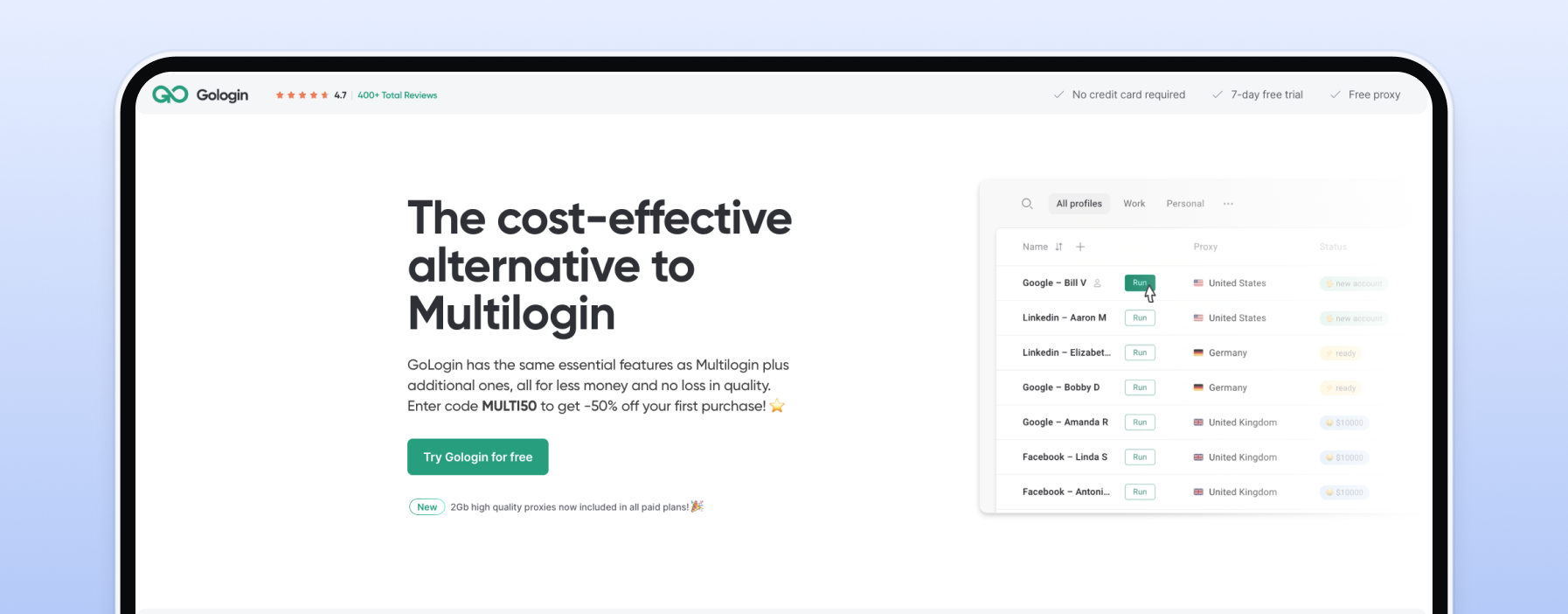
AdsPower vs Multilogin Homepage: Best Anti-Detect Browser? - Pricing: AdsPower's Free Plan vs Multilogin's Paid Tiers.
Pricing is the clearest dividing line between the two products.
According to Bright Data's AdsPower vs Multilogin comparison, AdsPower offers a Free Forever plan and its most expensive tier sits around $36/month, with quarterly and annual discounts of roughly 20% and 40%. Multilogin's entry plan was listed at €29/month, meaning AdsPower's top plan landed near Multilogin's lowest plan. Multilogin offered no free trial in that comparison, though IPRoyal later reported Multilogin restructuring entry pricing to around €9/month.
For teams running hundreds of lightweight profiles, that gap compounds fast. AdsPower's free tier with 2 profiles also lets you validate fingerprint quality and proxy setup before paying anything, which matters when you are testing whether an anti-detect browser actually holds up on your target platforms.
Practical example: An affiliate team spinning up 300 disposable profiles for ad verification would pay for 300 Multilogin seats or profiles at premium rates, versus scaling AdsPower tiers with annual discounts and no per-device hardware cost.
Fingerprint Control: Manual Toggles vs Engineered Profiles
AdsPower vs Multilogin Homepage: Best Anti-Detect Browser? - Fingerprint Control: Manual Toggles vs Engineered Profiles.
Both browsers modify the underlying Chromium engine so sites receive synthetic hardware profiles rather than script-level patches, but their philosophies differ.
- AdsPower exposes a large array of manual controls across Canvas, WebGL, AudioContext, network parameters, and user agent settings. IPRoyal notes this granularity suits teams that need to tune specific hardware spoofing parameters, but also warns that over-customization can create mathematically impossible profiles that trigger bans.
- Multilogin positions itself around a more cohesive, mathematically consistent fingerprint engine, which IPRoyal describes as delivering highly consistent hardware profiles with less manual tuning.
The trade-off is control versus guardrails. If you have fingerprint expertise, AdsPower gives you more knobs. If you want defaults that stay internally consistent, Multilogin's approach reduces the chance of self-inflicted detection.
Proxies: Bring Your Own vs Bundled Residential IPs
Proxy handling is where the two products diverge most in daily operations.
Multilogin now bundles premium residential proxy traffic into every subscription plan, which removes the need to shop for a separate provider. That convenience has a cost: you are paying for proxy traffic inside the subscription, and heavy users may still need external IPs for specific ISP targeting or when monthly allowances run out.
AdsPower takes the bring-your-own-proxy route. You paste a bulk proxy list into the dashboard and it auto-formats the entries, which IPRoyal notes processes bulk lists slightly faster than Multilogin. This suits teams that already have a preferred proxy vendor or need granular control over geolocation per profile.
If you are still deciding on infrastructure, it helps to understand how IP and fingerprint signals interact; see our explainer on what Whoer.net checks for IP, DNS, and fingerprint leakage basics before you commit to a proxy strategy.
Automation: Visual RPA vs Developer Integrations
Both platforms support Selenium, Puppeteer, and Playwright, so code-driven pipelines work on either. The difference is accessibility.
AdsPower ships a visual RPA builder inside the dashboard, letting you chain clicks and text inputs without writing code, and it adds an AI Agent with scheduled tasks for recurring workflows. IPRoyal explicitly credits AdsPower with winning on automation accessibility because of this integrated visual builder.
Multilogin focuses on API and driver integrations plus pre-farmed cookies for faster account warm-up. That is powerful for engineering-led teams, but non-technical operators will need developer support to build equivalent flows.
Practical example: A solo e-commerce seller restocking 40 marketplace accounts can schedule a visual RPA task in AdsPower to log in, check order status, and export data nightly, without maintaining a Selenium script.
Security, Compliance, and Team Management
AdsPower holds SOC 2 Type II, ISO 27001, and ISO 27701 certifications and encrypts profile data, with folder-based organization and granular permissions that let admins restrict junior staff from sensitive client environments. IPRoyal rates AdsPower's compartmentalization as superior for large, segmented teams.
Multilogin encrypts profile data locally before transmission and synchronizes identical profiles across remote team members via encrypted cloud storage, which IPRoyal rates as the stronger enterprise security architecture.
Both support two-factor authentication and proxy integration. Bright Data's comparison gave AdsPower the edge on stated security practices, while IPRoyal gave Multilogin the edge on enterprise-grade architecture. In practice, both are defensible; pick based on whether you value certification evidence or cloud profile parity across distributed teams.
Mobile Emulation and Cloud Phones
Multilogin's headline differentiator is Cloud Phones: actual virtual Android devices hosted entirely in the cloud, letting you run mobile-first platforms like TikTok or Instagram without consuming local hardware. AdsPower instead provides extensive local controls for simulating iOS and Android environments on your own machine.
If your workflow is mobile-app-first and you want zero local resource usage, Multilogin's cloud phones are a genuine structural advantage. If you prefer local control and lower recurring cost, AdsPower's local emulation covers most app-focused tasks.
System Requirements and Platform Support
Bright Data found Multilogin slightly lighter on disk space (1GB versus AdsPower's 2GB), while both target 4GB RAM in that comparison; IPRoyal lists 8GB+ recommended RAM for both. Windows, macOS (Intel and Apple silicon), and Linux are supported by both platforms.
This is the one category where Multilogin consistently wins: if you run on constrained hardware, its smaller footprint matters.
When to Choose AdsPower vs Multilogin Homepage
| Your priority | Better fit |
|---|---|
| Free plan and low entry cost | AdsPower |
| Managing thousands of lightweight profiles | AdsPower |
| Visual no-code automation and scheduled tasks | AdsPower |
| Granular manual fingerprint tuning | AdsPower |
| Bulk proxy list import with your own provider | AdsPower |
| Bundled residential proxies | Multilogin |
| Cloud-hosted Android devices | Multilogin |
| Minimal disk usage on limited hardware | Multilogin |
| Encrypted cloud profile parity across remote teams | Multilogin |
If you are weighing other budget alternatives alongside these two, our AdsPower vs ixBrowser comparison tests whether "forever free" claims hold up against AdsPower's fingerprint isolation and team tools, and the 2026 top 10 anti-detect browser ranking scores both products on fingerprint consistency, automation, and pricing.
Related reading
- Maskfog Fingerprint Browser Review: A Cross-Border Anti-Association Solution with Built-in Clean IPs - Based on official pricing page and third-party ranking evidence, this review covers Maskfog's clean IP devices, free environment policy, target users, setup flow, limitations, and buying criteria.
- What Is Whoer.net? IP, DNS & Fingerprint Checks Explained - Whoer.net is a free IP lookup and privacy checker that shows your IP, location, DNS leaks, proxy status, and browser fingerprint in one click.
- Top 10 Antidetect Browser Products 2026: Tested Ranking - Independent 2026 ranking of the top 10 antidetect browsers, scored on fingerprint consistency, automation, pricing, and free plans.
Sources and further reading
- MuLogin vs AdsPower: Which Antidetect Browser Wins in 2026? - MuLogin vs AdsPower full comparison. Features, pricing, and see why Multilogin outperforms both as the most reliable antidetect browser.
- AdsPower vs Multilogin: Which Antidetect Browser Is Right for You? - Compare AdsPower vs Multilogin to choose the ideal anti-detect browser for securely managing multiple accounts.
FAQ
Is AdsPower cheaper than Multilogin?
Yes, based on published comparisons. AdsPower offers a Free Forever plan and its highest tier was priced near Multilogin's lowest tier in Bright Data's 2026 comparison. Multilogin later adjusted entry pricing downward, but AdsPower still leads on free access and annual discounts.
Does Multilogin include proxies while AdsPower does not?
Multilogin bundles premium residential proxy traffic into every plan, while AdsPower requires you to bring your own proxy provider and import lists in bulk. AdsPower's approach is cheaper if you already have a proxy vendor; Multilogin's is simpler if you want one bill.
Can I transfer profiles between AdsPower and Multilogin?
No. The two platforms use proprietary browser engines, so profiles cannot be moved directly. You can export cookies, but you must generate a new fingerprint on the destination platform before logging back in.
Which has better automation for non-developers?
AdsPower. Its integrated visual RPA builder and AI Agent with scheduled tasks let you automate clicks and inputs without code, which IPRoyal identifies as its accessibility advantage. Multilogin relies more on API and driver integrations.
Which is better for mobile-first platforms like TikTok?
Multilogin's Cloud Phones run virtual Android devices entirely in the cloud, which suits mobile-app-first workflows without local hardware strain. AdsPower offers local iOS and Android emulation controls, which is sufficient for most app-focused tasks at lower cost.
Conclusion
The AdsPower vs Multilogin Homepage decision comes down to what you are optimizing for. AdsPower wins on pricing, free access, bulk proxy flexibility, visual automation, and team compartmentalization, backed by SOC 2 Type II, ISO 27001, and ISO 27701 certifications. Multilogin wins on bundled residential proxies, cloud-hosted Android phones, lighter disk requirements, and encrypted cloud profile parity for distributed enterprises.
For most multi-accounting operators scaling on a budget, AdsPower delivers comparable core capability at a fraction of the cost. If your workflow depends on cloud mobile devices or you want proxies included in one subscription, Multilogin justifies its premium. Test AdsPower's free plan first; it costs nothing and tells you quickly whether its fingerprint engine holds on your target platforms.


